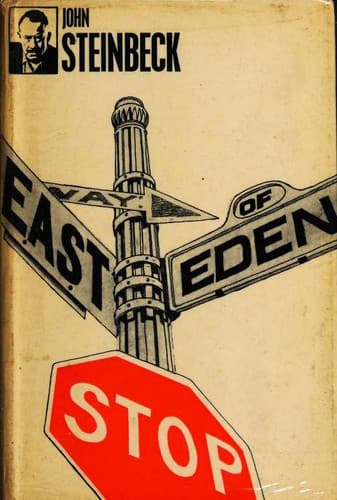
East of Eden (1952)
About This Book
Two families in California's Salinas Valley play out the story of Cain and Abel across three generations, and the question that drives the novel is whether human beings are fated to repeat the patterns of sin and violence, or whether the Hebrew word 'timshel,' meaning 'thou mayest,' grants them the freedom to choose their own moral destiny. John Steinbeck considered this his magnum opus, the novel that contained everything he knew about good, evil, and the American character.
Why It's a Classic
Steinbeck organized his most ambitious novel around a single Hebrew word, 'timshel,' and the interpretation of that word becomes the book's moral center: if God's command to Cain is 'thou shalt' (a promise of triumph over sin) or 'do thou' (an order), the meaning is passive, but if it means 'thou mayest,' it grants free will, and free will is the only thing that makes moral choice meaningful. Cathy Ames, who becomes Kate, is one of the most disturbing villains in American fiction: a woman Steinbeck describes as a 'monster' born without a moral sense, and whether this characterization is brilliant (a portrait of genuine sociopathy) or problematic (a misogynistic reduction of female agency to pure evil) has been debated since publication. The Chinese American servant Lee, who teaches himself Hebrew to investigate the meaning of 'timshel,' is the novel's intellectual hero and one of Steinbeck's most fully realized characters. Samuel Hamilton, based on Steinbeck's own maternal grandfather, embodies the warmth and wisdom that Steinbeck associated with the Salinas Valley itself. The novel's sweep, covering decades and generations, gives it the quality of an American Genesis.
Fun Fact
Steinbeck wrote the novel as a letter to his two sons, Thom and John, intending it as a record of their family history and the Salinas Valley where he grew up. He kept a daily journal during the writing process (published posthumously as 'Journal of a Novel: The East of Eden Letters') that reveals his ambitions and anxieties in remarkable detail. The 'timshel' passage required Steinbeck to consult with Hebrew scholars, and the resulting discussion in the novel took months to finalize. Critics were divided on publication: some hailed it as his masterpiece, while others found it overambitious and didactic. Steinbeck himself had no doubts: he told his editor, 'I think everything else I have written has been, in a sense, practice for this.'
Parent Note
The novel contains murder, attempted murder, prostitution (a major character runs a brothel), child abuse, suicide, war (World War I), and a character who is depicted as innately evil. The violence is sometimes graphic. The portrayal of Cathy/Kate has been criticized as misogynistic. Racial attitudes of the early twentieth century are depicted, including anti-Chinese sentiment, though the Chinese American character Lee is treated with great respect by the narrative. The novel is roughly 600 pages. Suitable for readers sixteen and up. A major American novel that rewards patient reading.
Quick Facts
- Year
- 1952
- Type
- 📚 Book
- Category
- Modern & Contemporary Literature
- Age Group
- Adults (Ages 18+)