Little Kids
Ages 3–6
Gentle classics perfect for the youngest readers and viewers
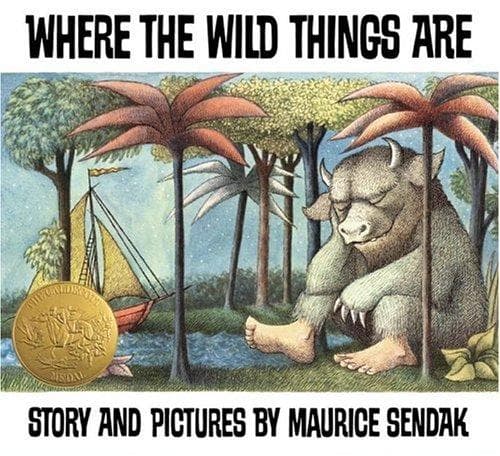
Max gets sent to bed without supper and sails away to a strange island where enormous wild creatures roar and gnash their teeth. He tames them all, becomes their king, and leads a glorious rumpus before choosing to return home to a warm meal. It is a ten minute read that feels like an entire odyssey.
Maurice Sendak accomplished something that almost no other picture book author has managed: he told a complete emotional arc in just 338 words. The Wild Things are genuinely frightening in their yellow eyes and terrible claws, and Sendak never softens them. Max does not defeat the monsters by being brave or clever; he stares into their eyes without blinking, and they recognize a fellow wild thing. The illustrations grow from small framed panels to full double page spreads as Max's imagination expands, then shrink back down as he returns home. That visual structure mirrors the rhythm of a child's tantrum: the swell of fury, the peak of abandon, the quiet exhaustion afterward. The final image of supper waiting in his room, still hot, says everything about parental love without a single word of explanation.
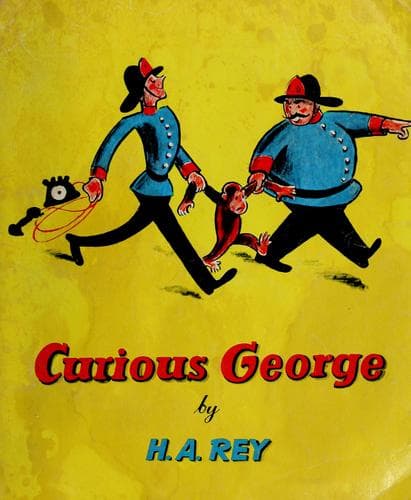
Curious George
(1941)A little monkey who cannot resist investigating everything gets scooped up from the jungle and brought to the big city, where his curiosity lands him in one scrape after another. The illustrations have a loose, joyful energy that makes every page feel like a new adventure. Children see their own unstoppable urge to explore reflected in George's wide eyes and restless hands.
Hans Augusto Rey and Margret Rey created one of the most durable characters in children's literature because George embodies something universal: the drive to touch, taste, and test everything in reach. The watercolor illustrations are deceptively simple, using clean lines and bright washes to convey motion and mischief without clutter. George never speaks, yet his body language communicates perfectly; the image of him floating away holding a bundle of balloons is one of the most iconic single pages in picture book history. The Reys' own story adds a layer of poignancy, as they fled Paris on bicycles during the Nazi occupation with the manuscript in their bags. George's adventures have remained in print for over eighty years because they tap into childhood's purest impulse: the need to know what happens next.
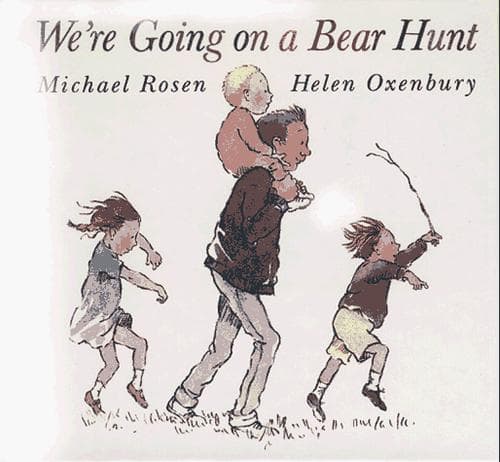
A father and four children march through squelching mud, swirling snowstorms, and thick oozy grass on a quest to find a bear, chanting "We can't go over it, we can't go under it" at every obstacle. When they finally find the bear, the whole adventure reverses in a glorious panic. Reading it aloud is a full body experience: you will be stomping, swishing, and splashing whether you mean to or not.
Michael Rosen built this book on a campfire chant he had been performing for years, and that oral tradition gives the text a rhythmic momentum that is almost impossible to resist. Helen Oxenbury's illustrations alternate between black and white pencil sketches for the journey and full color paintings for each obstacle, creating a visual pulse that matches the text's call and response pattern. The repetition is structurally brilliant: each new obstacle raises the stakes, and when the bear finally appears, the story replays every scene in reverse at triple speed, giving children the thrill of recognition as they race back through familiar territory. The final page, showing the bear trudging alone on the beach, adds a note of genuine melancholy that elevates the whole book. Rosen understands that the best children's stories contain real feelings, not just entertainment.
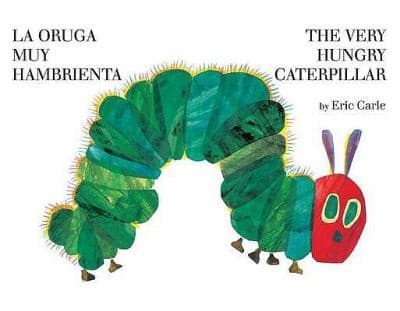
A tiny caterpillar eats his way through apples, plums, strawberries, chocolate cake, ice cream, and an increasingly absurd pile of food before spinning a cocoon and emerging as a spectacular butterfly. The pages themselves have holes punched through them where the caterpillar has eaten, turning reading into a tactile experience. It teaches counting, days of the week, and the wonder of metamorphosis without ever feeling like a lesson.
Eric Carle invented a new kind of picture book with this title, one where the physical object itself is part of the storytelling. The die-cut holes let toddlers poke their fingers through the pages, transforming a passive reading experience into an interactive one. Carle's tissue paper collage technique produces colors that feel saturated and alive, almost edible, which is exactly right for a book about consuming the world. The narrative structure is sneakily sophisticated: it moves through a predictable counting pattern, breaks that pattern with the Saturday binge, introduces a consequence (the stomachache), and resolves with transformation. That arc mirrors a child's own experience of excess and recovery in miniature. The final butterfly spread, with its enormous wings filling both pages, delivers a genuine moment of awe that never diminishes no matter how many times you read it.
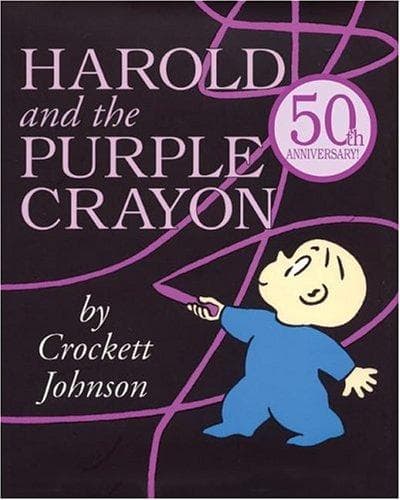
A small boy in pajamas picks up an oversized purple crayon and draws himself an entire world: a path to walk on, a moon to light his way, a mountain to climb, and an ocean to sail across. Every problem Harold encounters he solves by drawing the next thing he needs. The simplicity of the white page filling with purple lines makes every child feel that the same power lives in their own hands.
Crockett Johnson stripped picture book illustration down to its most essential elements: a blank page, a single color, and a child's line. The genius of the concept is that Harold is simultaneously the protagonist, the author, and the illustrator of his own story, which makes the book a meditation on creativity itself. When Harold draws nine kinds of pie and then draws a moose and a porcupine to eat them, Johnson captures the free associative logic of childhood play perfectly. The book also contains a genuinely philosophical tension: Harold controls his world completely, yet he keeps drawing himself into trouble, suggesting that imagination carries real consequences even in fantasy. Johnson's spare, wobbly line has the look of a child's own drawing, which is precisely the point. The final scene, where Harold draws his bedroom window and tucks himself into his drawn bed, closes the loop with a quiet elegance that picture books rarely achieve.
Strega Nona
(1975)In a Calabrian village, the old witch Strega Nona leaves her helper Big Anthony alone with her magic pasta pot, despite warning him never to touch it. Big Anthony fires up the pot and feeds the whole town, then watches in horror as the pasta keeps coming and coming and will not stop. The flood of pasta through the village streets is one of the great slapstick images in picture books.
Tomie dePaola retold an old Italian folktale and made it so completely his own that most people think he invented it. His folk art illustrations, with their warm earth tones and rounded forms, create a world that feels both ancient and cozy, like a story your grandmother might tell by the fire. The comedy works because dePaola understood pacing: Big Anthony's confidence grows panel by panel until the pasta overflows, and the catastrophe escalates in perfect comedic rhythm. The punishment at the end, where Big Anthony must eat all the excess pasta, is satisfying in the way that fairy tale justice always is, proportional and slightly absurd. DePaola also gave Strega Nona a quiet dignity that makes her more than just a plot device; she is wise, patient, and a little bit amused by human foolishness. The book won a Caldecott Honor and launched a beloved series, but this first volume remains the tightest and funniest of them all.
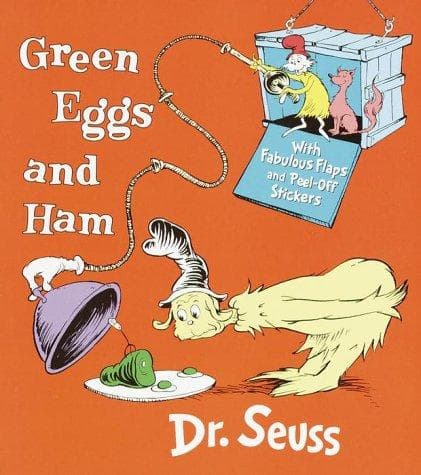
Green Eggs and Ham
(1960)The relentless Sam-I-Am pursues a grumpy unnamed character across increasingly ridiculous locations, from boats to trains to treetops, trying to convince him to taste green eggs and ham. The rhymes are so perfectly constructed that toddlers memorize entire passages after just a few readings. It is a story about trying new things, told with manic energy and zero subtlety, exactly the way kids like it.
Dr. Seuss wrote this book on a bet with his publisher Bennett Cerf, who wagered that Seuss could not write an entertaining book using only fifty different words. Seuss won the bet and created one of the bestselling children's books in history. The constraint forced an incredible economy of language: Seuss builds escalating comedy through nothing but rearrangement and repetition, the way a jazz musician works variations on a simple theme. Sam-I-Am's persistence is funny because it is so unreasonable, and the final capitulation, when the grumpy character actually enjoys the green eggs and ham, delivers real satisfaction. The book also works as a child's first encounter with persuasive rhetoric; Sam-I-Am never gives up, never changes his pitch, and eventually wears down all resistance through sheer cheerful persistence. Seuss understood that children find repetition comforting and escalation thrilling, and this book delivers both in perfect measure.
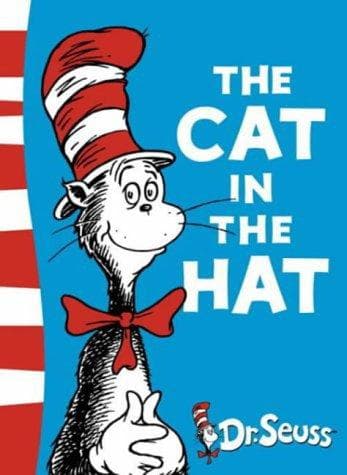
The Cat in the Hat
(1957)Two bored children stuck inside on a rainy day get an uninvited visit from a tall cat in a striped hat who proceeds to wreck their house with increasingly chaotic games, aided by Thing One and Thing Two. The goldfish protests, the children stare, and the mess grows to impossible proportions before the Cat cleans it all up seconds before Mother walks in. It is anarchy between covers, and every child recognizes the thrill.
Seuss wrote The Cat in the Hat as a direct response to Rudolf Flesch's 1955 polemic "Why Johnny Can't Read," which attacked the dullness of Dick and Jane primers. Using a limited vocabulary of roughly 220 words, Seuss proved that controlled vocabulary did not have to mean controlled fun. The Cat himself is one of literature's great trickster figures, in the tradition of Loki and Coyote, bringing chaos that is terrifying and liberating in equal measure. The tension between the rule-following fish and the anarchic Cat gives the book a genuine moral complexity: the children never decide whether to stop the Cat, and that ambiguity is part of the book's lasting power. Seuss's anapestic tetrameter drives the text forward with relentless momentum, making the reading experience feel like a ride you cannot get off. The book did not merely entertain; it restructured how America taught children to read, launching the Beginner Books series that became the foundation of early literacy for generations.
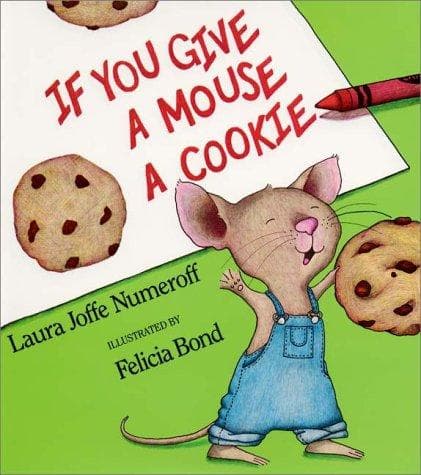
A boy offers a mouse a cookie, and the mouse then needs milk, a straw, a napkin, a mirror, scissors, a broom, and so on in an escalating chain of demands that circles all the way back to another cookie. Each request follows logically from the last, creating a comedic snowball that kids find both hilarious and deeply satisfying. It is the picture book equivalent of watching dominoes fall.
Laura Numeroff constructed a perfect circular narrative, one of the hardest structures to execute in any form of storytelling because the ending must feel both surprising and inevitable. Felicia Bond's illustrations carry enormous comic weight; the mouse grows more comfortable and more demanding in each scene, while the boy's expressions shift from generosity to bewilderment to exhaustion. The book teaches cause and effect without ever announcing that it is teaching anything, which is the hallmark of great children's literature. Numeroff's genius was recognizing that the chain of events mirrors how children actually think: associatively, one idea triggering the next without any sense of proportion. The final page, which loops back to the cookie, gives children the pleasure of closure and the excitement of imagining the whole cycle starting again. The book launched an entire series of "If You Give" titles, but this original remains the tightest and most inventive of the group.
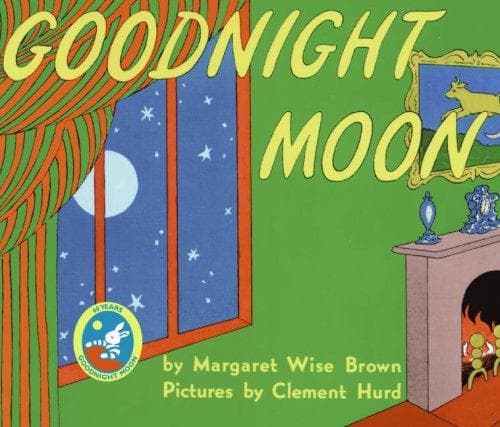
Goodnight Moon
(1947)A little bunny lies in bed in a great green room, saying goodnight to everything he sees: the red balloon, the bowl of mush, the quiet old lady whispering hush, the stars, the air, and noises everywhere. The room gradually darkens page by page as the ritual of naming and releasing each object lulls the reader toward sleep. It is less a story than a spell, and it works every single time.
Margaret Wise Brown understood something profound about how young children experience the world: they need to name things in order to let go of them. The book's genius is its structure of accumulation and release, first cataloguing every object in the room, then saying goodnight to each one, slowly emptying the child's attention until nothing remains but sleep. Clement Hurd's illustrations shift from bright full color spreads to increasingly dark and muted tones, matching the dimming of consciousness as bedtime takes hold. The "quiet old lady whispering hush" appears and disappears without explanation, adding a note of gentle mystery. Brown's language is incantatory; the shift from rhyming couplets to free verse to the final "goodnight noises everywhere" creates a cadence that physically slows a child's breathing. Nearly eighty years after publication, it remains the most widely used bedtime book in the English language because it does not merely depict bedtime; it enacts it.
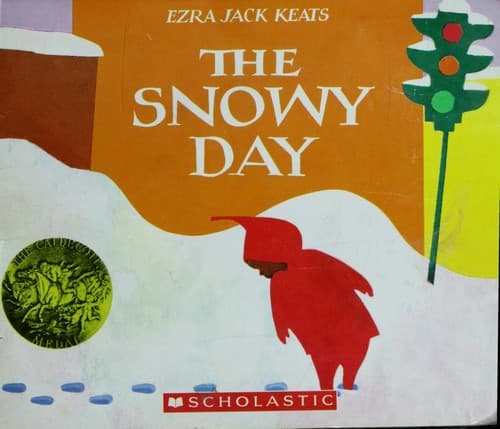
The Snowy Day
(1962)A young boy named Peter wakes up to find snow covering his neighborhood and spends the day making tracks, smacking snow off branches, building a snowman, and making snow angels. He tries to save a snowball in his pocket for later and discovers, with quiet sadness, that it has melted. Keats's collage illustrations glow with the muffled magic of a city transformed by fresh snow.
Ezra Jack Keats made history with this book: it was the first full color picture book from a major American publisher to feature a Black child as the protagonist, published at the height of the Civil Rights Movement. Keats never draws attention to Peter's race within the story, which was itself a radical act; Peter is simply a child experiencing snow, and his joy is universal. The collage technique, using cut paper, fabric, and paint, creates textures that feel tangible: you can almost feel the crunch of snow under Peter's feet. The snowball in the pocket is one of picture book literature's most poignant small moments, capturing the way children encounter impermanence for the first time. Keats's palette of pinks, whites, and blues against Peter's bright red snowsuit makes every page visually stunning. The book won the Caldecott Medal in 1963 and opened the door for greater representation in children's publishing, a legacy that extends far beyond its artistic achievements.
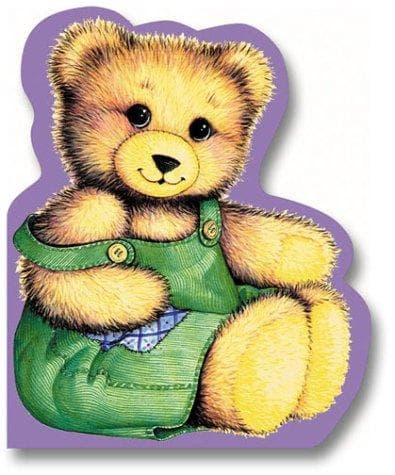
Corduroy
(1968)A small stuffed bear sits on a department store shelf, missing one button on his green overalls, and no one buys him. After the store closes, he climbs down and searches the entire store for his lost button in a nighttime adventure that feels enormous from his tiny perspective. A little girl named Lisa comes back the next morning with her own money to take him home, and she sews on a new button herself.
Don Freeman wrote a story about a stuffed animal that secretly contains one of the most powerful messages in children's literature: you do not have to be perfect to be loved. Corduroy's nighttime journey through the department store is rendered with a sense of scale that puts the reader inside a small bear's experience; the escalator becomes a mountain, and the mattress department becomes a vast landscape of hills. Lisa is notable because she is a Black girl making her own purchasing decision with her own saved money, a detail that was quietly groundbreaking in 1968. Freeman never sentimentalizes the relationship; Lisa does not pity Corduroy, and Corduroy does not grovel with gratitude. They simply recognize each other as friends. The final line, "You must be a friend. I've always wanted a friend," is one of the most emotionally direct endings in picture books, and it lands every time because Freeman earned it through restraint rather than manipulation.
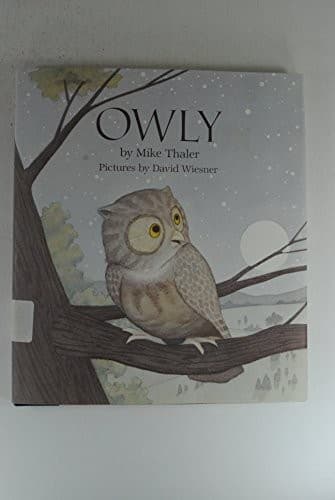
Owly: The Way Home
(2004)A kind, lonely owl tries desperately to make friends, but every animal he approaches runs away in fear because owls are predators. When he rescues a lost worm, an unlikely friendship forms between two creatures who need each other. The entire story is told without words, using only pictures, symbols, and expressive eyes that communicate everything.
Andy Runton solved one of the hardest problems in comics for young children: how to tell a genuinely emotional story that pre-readers can follow entirely on their own. By eliminating words completely and replacing dialogue with pictographic symbols (a lightbulb for an idea, a broken heart for sadness), Runton made a book that works across languages and reading levels. The linework is simple and rounded, with thick black outlines that make every expression legible even to toddlers. Owly's loneliness is real and palpable; the early pages where animals flee from him carry genuine pathos without ever becoming heavy. Runton also embedded lessons about panel flow and sequential reading into the storytelling itself, making Owly an intuitive introduction to how comics work. The friendship between Owly and Wormy, two creatures that nature would normally pit against each other, gives the book a thematic depth that rewards rereading long after a child has outgrown the format.
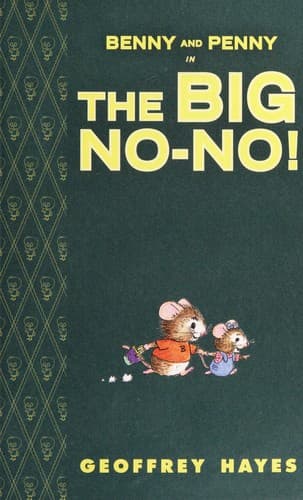
Mouse siblings Benny and Penny squabble, scheme, and stumble through short adventures that capture the texture of real sibling life with uncanny accuracy. The speech bubbles use simple, repetitive language designed for beginning readers, while the illustrations carry enough visual humor to keep pre-readers engaged. Each book in the series is a self-contained story short enough to finish in one sitting, giving new readers the enormous satisfaction of completing a "real" book.
Geoffrey Hayes created Benny and Penny as part of the Toon Books line, which was founded by Francoise Mouly (the art editor of The New Yorker) specifically to bring real comics storytelling to the earliest readers. Hayes understood that young children need facial expressions and body language to carry meaning, so his panels are filled with physical comedy and exaggerated reactions that communicate the emotional beats even when a child stumbles over the words. The sibling dynamic between bossy older Benny and stubborn little Penny rings completely true; their arguments, truces, and reconciliations follow the exact rhythms that any parent of two children will recognize. The comics format teaches left to right reading, panel sequencing, and the connection between image and text in ways that traditional picture books do not. Hayes kept his page layouts clean and uncluttered, rarely using more than four panels per page, which prevents the visual overwhelm that more complex comics can create for new readers. The series won multiple Theodor Seuss Geisel Awards, recognizing its achievement in the field of beginning reader books.
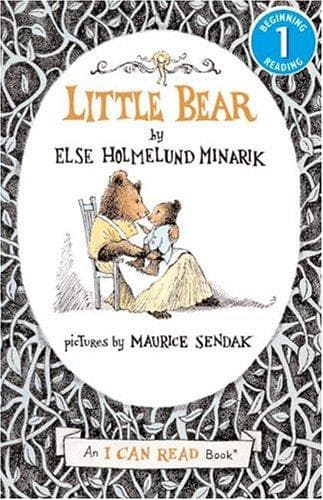
Little Bear
(1957)A young bear makes birthday soup, takes an imaginary trip to the moon, and has quiet conversations with his patient, loving mother in a series of short, gentle stories that feel like the coziest afternoon imaginable. Maurice Sendak's ink illustrations give each scene a warmth and softness that perfectly matches the unhurried pace of the text. These are stories where nothing dramatic happens, and everything matters.
Else Holmelund Minarik wrote Little Bear as one of the first true early reader books, predating even the I Can Read series that would eventually publish it. The genius of the book is its emotional sophistication within a severely limited vocabulary; Mother Bear's gentle, patient responses to Little Bear's requests convey an entire relationship in just a few words per page. Sendak's illustrations, done in delicate crosshatching, add layers of feeling that the simple text cannot carry alone. The birthday soup chapter, where Little Bear's friends arrive one by one to share his meal, has a cumulative warmth that builds through repetition and generosity. Minarik understood that beginning readers need stories that respect their intelligence while accommodating their limitations, and she never condescended. The collaboration between Minarik's spare text and Sendak's rich illustrations created a template that early reader books have followed ever since, proving that simplicity and depth are not opposites.
Best Classic Books and Movies for Little Kids (Ages 3–6)
Finding the right books and movies for 3, 4, 5, and 6 year olds can be overwhelming. Our curated list focuses on timeless classics that have delighted generations of little ones. From beloved picture books for preschoolerslike “Goodnight Moon” and “The Very Hungry Caterpillar” to gentle animated movies for toddlers and preschoolerslike “Toy Story” and “My Neighbor Totoro,” every pick is age-appropriate, parent-approved, and guaranteed to stand the test of time.