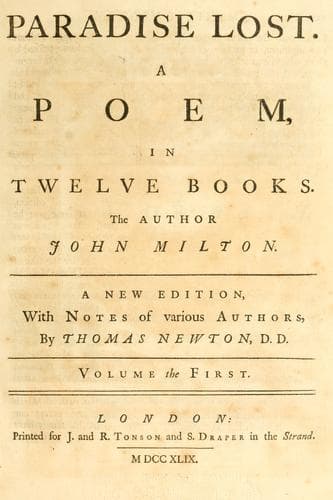
Paradise Lost (1667)
About This Book
Satan, cast out of Heaven after a failed rebellion against God, journeys through Chaos to the newly created Earth, where he corrupts Adam and Eve in the Garden of Eden, bringing sin, death, and suffering into the world. John Milton wrote an epic poem that was supposed to 'justify the ways of God to men' and instead created literature's most compelling villain, a figure whose defiant grandeur has captivated readers for nearly four centuries.
Why It's a Classic
Milton gave Satan the best lines, the most memorable speeches, and the most psychologically complex interior life in the poem, and whether this was deliberate subversion or unintentional brilliance has been debated since William Blake observed that Milton was 'of the Devil's party without knowing it.' Satan's opening address to his fallen angels ('Better to reign in Hell than serve in Heaven') established the template for every charismatic, sympathetic villain in Western fiction. The poem's depiction of the Garden of Eden, rendered in some of the most beautiful blank verse in the English language, creates a world of sensory richness that makes the Fall feel like a genuine loss rather than an abstract theological concept. Milton's God, by contrast, is a rhetorical problem: he speaks in syllogisms and justifications that can seem cold and authoritarian compared to Satan's passionate eloquence. The poem's exploration of free will, disobedience, and the relationship between creator and creation resonates with every subsequent narrative about rebellion against authority.
Fun Fact
Milton was completely blind when he composed most of the poem, dictating it to his daughters and amanuenses. He began the poem during the English Civil War and completed it after the Restoration, when the republican cause he had supported was defeated and he himself was briefly imprisoned. His own experience of political defeat and disillusionment infuses Satan's speeches with a conviction that suggests deep personal identification. The poem's opening invocation ('Of Man's First Disobedience, and the Fruit / Of that Forbidden Tree') begins in the middle of the action (in medias res), following the convention established by Homer. Philip Pullman's His Dark Materials trilogy is explicitly a response to and reimagining of Paradise Lost.
Parent Note
The poem contains scenes of cosmic warfare, the temptation and Fall of humanity, descriptions of Hell, and theological arguments about predestination, free will, and divine justice. The depiction of Adam and Eve includes their sexuality (presented positively as part of Eden's perfection). The language is seventeenth century blank verse and is among the most challenging in English poetry; the sentences can run for dozens of lines. The poem is roughly 10,500 lines. Modern annotated editions (such as the Norton Critical Edition) are essential for most readers. Suitable for readers sixteen and up with an interest in poetry or theology. A foundation of English literature that has influenced every major English-language poet since.
Quick Facts
- Year
- 1667
- Type
- 📚 Book
- Category
- Epics & Foundational Texts
- Age Group
- Adults (Ages 18+)