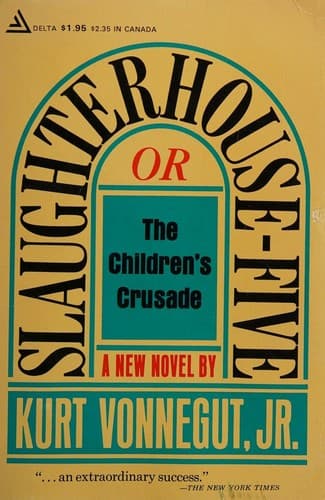
Slaughterhouse-Five (1969)
About This Book
Billy Pilgrim, a chaplain's assistant in World War II, becomes 'unstuck in time' and experiences his life in nonlinear fragments: his survival of the firebombing of Dresden, his postwar career as an optometrist, his abduction by aliens from the planet Tralfamadore, and his eventual assassination. Kurt Vonnegut wrote the definitive antiwar novel by refusing to tell a war story in any conventional way.
Why It's a Classic
Vonnegut's genius was recognizing that the horror of Dresden, where an estimated 25,000 civilians were killed in Allied firebombing raids, could not be captured by a traditional war narrative, so he shattered the story into fragments and reassembled it as science fiction, autobiography, and dark comedy simultaneously. The phrase 'So it goes,' repeated after every mention of death, becomes both a coping mechanism and an indictment: by the time the reader has encountered it a hundred times, the words have accumulated a weight that makes them feel like either the wisest or the most helpless response to mass death imaginable. Billy Pilgrim's passivity, his inability to prevent or resist anything that happens to him, is Vonnegut's commentary on the individual's powerlessness in the face of mechanized warfare. The Tralfamadorian philosophy that all moments exist simultaneously and death is just one of them reads as both a genuine comfort and a devastating critique of fatalism. The novel's opening chapter, in which Vonnegut writes about himself trying to write the book, is a masterclass in the difficulty of representing atrocity.
Fun Fact
Vonnegut was a prisoner of war in Dresden during the firebombing on February 13, 1945, and survived by sheltering in an underground meatlocker in a slaughterhouse (Slaughterhouse Five). It took him twenty-three years to write the novel because he could not find a form adequate to the experience. The phrase 'so it goes' appears 106 times in the novel. Vonnegut's original subtitle, 'The Children's Crusade,' was suggested by the wife of a fellow veteran who pointed out that the soldiers were barely more than children when they fought. The novel has been banned repeatedly in American schools and libraries, which Vonnegut addressed with characteristic wit.
Parent Note
The novel contains descriptions of war violence (firebombing, shootings, prisoner of war conditions), brief sexual content, dark humor about death and suffering, and a nonlinear structure that can be disorienting for unprepared readers. The repeated references to death, treated with apparent casualness, are intentionally unsettling. There is brief nudity and a sexual encounter. Language is mild by contemporary standards. The novel is short (roughly 275 pages) and accessible despite its experimental structure. Suitable for readers fifteen and up. One of the most frequently assigned and frequently banned novels in American education.
Quick Facts
- Year
- 1969
- Type
- 📚 Book
- Category
- Fantasy / Sci-Fi
- Age Group
- Adults (Ages 18+)