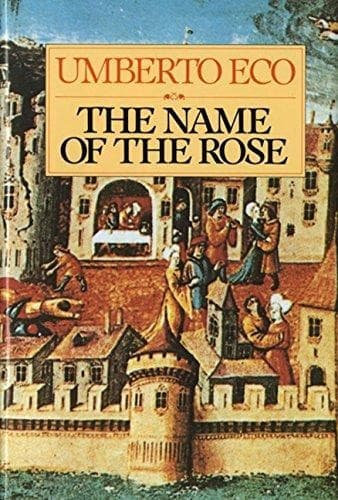
The Name of the Rose (1980)
About This Book
In 1327, a Franciscan friar and his young apprentice arrive at a wealthy Italian monastery to participate in a theological debate, and when monks begin dying in ways that echo the Book of Revelation, the friar applies Aristotelian logic to unravel a mystery that leads to a secret library and a lost text that powerful men will kill to keep hidden. Umberto Eco, a professor of semiotics, wrote a detective novel that is also a treatise on medieval philosophy, the politics of laughter, and the nature of interpretation.
Why It's a Classic
Eco demonstrated that intellectual density and narrative suspense are not only compatible but mutually reinforcing: the theological debates, the discussions of Aristotelian logic, and the political intrigues of the Franciscan-papal conflict provide both the motive for murder and the method of detection. Brother William of Baskerville (a name that tips its hat to both Sherlock Holmes and William of Ockham) is one of fiction's great detectives, a man whose commitment to reason puts him in opposition to a Church that values authority over inquiry. The labyrinthine library, which physically embodies the novel's themes about the organization and suppression of knowledge, is one of literature's most memorable settings. Eco's use of multiple narrative frames (a modern introduction, a medieval narrator, texts within texts) transforms the novel into a demonstration of the very semiotic theories he taught at the University of Bologna. The debate about whether laughter is acceptable to God, which drives the plot, is both a genuine medieval controversy and Eco's commentary on the politics of controlling what people find funny.
Fun Fact
Eco initially intended the novel's audience to be a small circle of fellow academics and was astonished when it became an international bestseller, selling over fifty million copies. He wrote the novel partly as a practical demonstration of his semiotic theories, showing how signs and interpretation operate within a narrative. The monastery in the novel is fictional, but Eco researched medieval monastic life so extensively that historians have praised the novel's accuracy. Sean Connery starred as William of Baskerville in the 1986 film adaptation. The novel's title, which Eco said he chose because 'the rose is a figure so rich in meanings that by now it hardly has any meaning left,' is itself a semiotic puzzle.
Parent Note
The novel contains murder by various means (poisoning, defenestration, drowning), descriptions of Inquisitorial torture and burning at the stake, a sexual encounter between a monk and a peasant girl, theological debates that may challenge readers unfamiliar with medieval Christianity, and themes of censorship and intellectual freedom. The prose is dense and the pacing deliberate, with extensive digressions on architecture, theology, and philosophy. The novel is long (roughly 500 pages) and intellectually demanding. Suitable for readers seventeen and up with patience for philosophical fiction. Deeply rewarding for readers willing to engage with its complexity.
Quick Facts
- Year
- 1980
- Type
- 📚 Book
- Category
- Mystery
- Age Group
- Adults (Ages 18+)