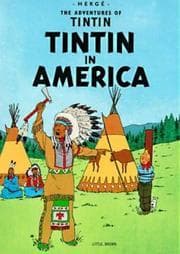
The Adventures of Tintin (1929)
About This Book
Tintin, a young Belgian journalist with a white terrier named Snowy, travels the world investigating crimes, toppling conspiracies, and getting into hair-raising scrapes from the deserts of North Africa to the temples of South America to the surface of the moon. Captain Haddock, his irascible, whisky-loving companion, and the bumbling detectives Thomson and Thompson provide comedy alongside the adventure. The stories move with the precision and speed of the best action films.
Why It's a Classic
Herge developed his ligne claire art style, characterized by clean, precise lines and flat, vivid colors, into one of the most distinctive and influential visual languages in comics history. Every panel is composed with architectural precision; backgrounds are meticulously researched and drawn, vehicles and buildings are accurate to their real-world counterparts, and the action sequences flow with cinematic clarity. Captain Haddock, introduced in the ninth album, transformed the series by giving Tintin a partner whose emotional volatility and colorful vocabulary ("Billions of blistering blue barnacles!") balanced Tintin's unflappable composure. Herge spent months researching each adventure, traveling to locations and studying local cultures, which gives even the most far-fetched plots a foundation of authentic detail. The series has sold over 250 million copies in more than 70 languages, and its influence on European comics, animation, and graphic storytelling is incalculable.
Fun Fact
Herge suffered a nervous breakdown while working on Tintin in Tibet, which he considered his most personal work, and his therapist advised him to stop drawing, but he refused. The two-part adventure Destination Moon and Explorers on the Moon, published in the 1950s, depicted a moon landing with remarkable scientific accuracy more than a decade before Apollo 11. Steven Spielberg acquired the film rights after reading a favorable review comparing Raiders of the Lost Ark to Tintin, and he eventually produced a motion-capture film adaptation in 2011.
Parent Note
The early albums (especially Tintin in the Congo and Tintin in America) contain racial stereotypes and colonial attitudes that reflect the era in which they were drawn. Later albums are significantly more nuanced and researched. There is cartoon violence throughout, including gunfights and explosions, all of it bloodless and presented in an action-adventure style. Best for ages 7 and up, and the early albums' problematic content is worth discussing with children.
Quick Facts
- Year
- 1929
- Type
- 📚 Book
- Category
- Graphic Novels / Comics
- Age Group
- Kids (Ages 7–10)