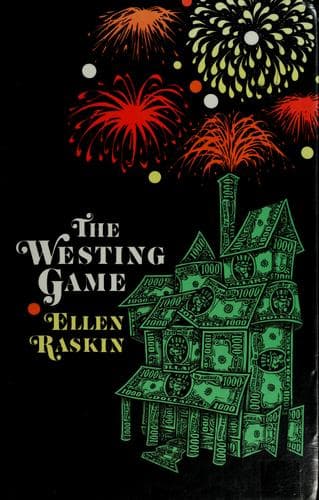
The Westing Game (1978)
About This Book
When eccentric millionaire Sam Westing dies, sixteen heirs are gathered for the reading of his will and given a set of cryptic clues, paired into teams of two, and told that one of them is the murderer. As the heirs scheme, spy, and puzzle their way through the game, alliances shift and identities unravel in a plot that rewards the most attentive reader. It's an intricate puzzle box of a novel that demands to be reread.
Why It's a Classic
Ellen Raskin constructed one of the most tightly plotted mystery novels ever written for any audience, not just children. Every character name, every clue, every seemingly random detail connects to the solution in ways that only become visible on a second reading. Raskin was a graphic designer before she was a novelist, and that visual, pattern-oriented thinking infuses the book's structure; the clues are literally laid out for inspection, inviting the reader to arrange and rearrange them. The sixteen heirs are drawn from a remarkably diverse range of backgrounds, and Raskin treats each one with specificity and respect, avoiding stereotypes even as she uses the conventions of the mystery genre. The book won the Newbery Medal in 1979, and it stands as proof that children's literature can be as formally ambitious and intellectually demanding as anything written for adults.
Fun Fact
Raskin was a highly accomplished graphic designer and illustrator before she started writing novels, and she designed the covers of over a thousand books, including the original cover of A Wrinkle in Time. She was diagnosed with the connective tissue disease that would eventually kill her while writing The Westing Game, and she completed the book knowing it might be her last. The puzzle in the novel is fully solvable by the reader, and Raskin planted the answer in the very first chapter for anyone sharp enough to spot it.
Parent Note
The plot involves a death and a murder mystery, but the tone is more puzzle than thriller, and there is no graphic violence. Some of the wordplay and structural complexity will challenge younger readers. This book is best appreciated by ages 10 and up, and it makes an outstanding classroom or family read because everyone can puzzle through the clues together.
Quick Facts
- Year
- 1978
- Type
- 📚 Book
- Category
- Mystery
- Age Group
- Kids (Ages 7–10)