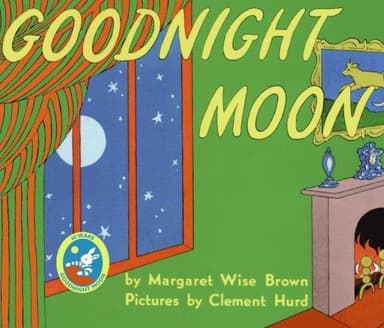
Goodnight Moon (1947)
About This Book
A little bunny lies in bed in a great green room, saying goodnight to everything he sees: the red balloon, the bowl of mush, the quiet old lady whispering hush, the stars, the air, and noises everywhere. The room gradually darkens page by page as the ritual of naming and releasing each object lulls the reader toward sleep. It is less a story than a spell, and it works every single time.
Why It's a Classic
Margaret Wise Brown understood something profound about how young children experience the world: they need to name things in order to let go of them. The book's genius is its structure of accumulation and release, first cataloguing every object in the room, then saying goodnight to each one, slowly emptying the child's attention until nothing remains but sleep. Clement Hurd's illustrations shift from bright full color spreads to increasingly dark and muted tones, matching the dimming of consciousness as bedtime takes hold. The "quiet old lady whispering hush" appears and disappears without explanation, adding a note of gentle mystery. Brown's language is incantatory; the shift from rhyming couplets to free verse to the final "goodnight noises everywhere" creates a cadence that physically slows a child's breathing. Nearly eighty years after publication, it remains the most widely used bedtime book in the English language because it does not merely depict bedtime; it enacts it.
Fun Fact
Clement Hurd was a heavy smoker, and early editions of the book contained a photograph of him on the back cover holding a cigarette, which was quietly airbrushed out by the publisher in later printings. Margaret Wise Brown died at only 42, and she left the royalties from Goodnight Moon to a nine year old neighbor boy. The book was panned by the New York Public Library upon release and was not stocked on their shelves for over twenty years.
Parent Note
This is arguably the safest book in existence. There is nothing scary, sad, or complicated anywhere in its pages. It works from birth onward; newborns respond to the rhythm of the language, and toddlers love pointing at the objects on each page. The only parental challenge is that you will read it so many thousands of times that you will have it memorized against your will.
Quick Facts
- Year
- 1947
- Type
- 📚 Book
- Category
- Classics
- Age Group
- Little Kids (Ages 3–6)