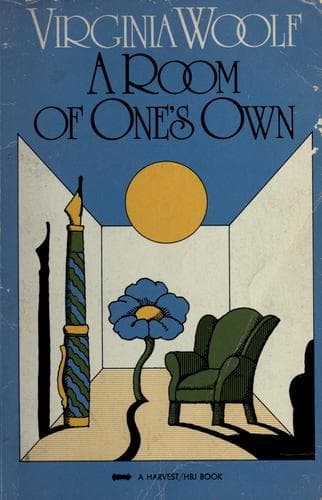
A Room of One's Own (1929)
About This Book
Virginia Woolf delivers a series of lectures at Cambridge arguing that women have been prevented from producing literature not by lack of talent but by lack of money and privacy, and she imagines a 'Shakespeare's sister' who possessed her brother's genius but was denied education, independence, and the room of her own in which to write. The essay is the foundational text of feminist literary criticism and one of the most brilliant pieces of argumentative prose in English.
Why It's a Classic
Woolf's argument is both structural and imaginative: she traces the material conditions (money, space, freedom from domestic obligation) that writing requires and demonstrates that women have been systematically denied every one of them, and then she creates the fictional Judith Shakespeare to make the abstract argument heartbreakingly concrete. Judith, who possesses William's genius but is denied his opportunities, ends up pregnant, desperate, and dead by suicide, and Woolf's point is not that this particular woman existed but that the social conditions that would produce her fate certainly did exist and continued to exist in 1929. The essay's prose style is itself an argument: Woolf writes with a conversational freedom, moving between anecdote, historical research, literary analysis, and fiction, that demonstrates the kind of intellectual liberty she is advocating for. Her observation that 'a woman must have money and a room of her own if she is to write fiction' has become one of the most quoted sentences in feminist thought because it reduces a complex political argument to a simple, undeniable material claim.
Fun Fact
The essay originated as two lectures Woolf delivered at Newnham and Girton colleges, the women's colleges at Cambridge University, in October 1928. Woolf described being stopped by a beadle (a university official) and told she could not walk on the grass because she was a woman, an incident that opens the essay and establishes its central concern with the physical and institutional barriers women face. At the time of the lectures, women at Cambridge could attend lectures and sit examinations but were not granted full degrees; this did not change until 1947. The 'five hundred pounds a year' that Woolf cites as the minimum income necessary for creative freedom was based on an inheritance she herself received from an aunt, which she credited with liberating her writing life.
Parent Note
The essay discusses the historical exclusion of women from education, property ownership, and creative life. It contains references to poverty, the death of an imagined character by suicide, and the systemic marginalization of women throughout history. There is no graphic content, violence, or strong language. The prose is accessible and engaging. The essay is short (roughly 110 pages). Some historical references and literary allusions may require context. Suitable for readers fifteen and up. Essential reading for feminist thought, literary criticism, and the history of women's writing.
Quick Facts
- Year
- 1929
- Type
- 📚 Book
- Category
- Non-Fiction / Memoir
- Age Group
- Adults (Ages 18+)