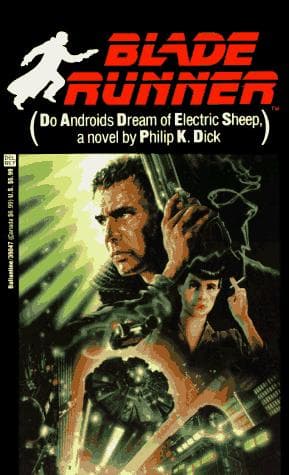
Do Androids Dream of Electric Sheep? (1968)
About This Book
In a post-nuclear San Francisco where most animals are extinct and replaced by robotic replicas, a bounty hunter named Rick Deckard is assigned to 'retire' six escaped androids who are physically indistinguishable from humans, and the job forces him to question what separates the authentic from the artificial. Philip K. Dick wrote the novel that became Blade Runner and that anticipated our era's deepest anxiety: the fear that nothing is real.
Why It's a Classic
Dick's genius was asking philosophical questions through pulp fiction premises, and this novel's central question, how do you identify and empathize with something that perfectly mimics humanity, has become the defining question of the artificial intelligence era. The Voigt-Kampff test, which measures empathic response to detect androids, is the novel's most brilliant invention: it suggests that what makes us human is not intelligence or consciousness but the capacity to feel for another being, and the novel systematically undermines even this definition. Deckard's growing sympathy for the beings he is supposed to kill, his uncertainty about his own authenticity, and the novel's refusal to provide a clean answer create a reading experience of escalating philosophical vertigo. Dick's depiction of a world where real animals are status symbols and artificial ones are substitutes for genuine connection anticipated the era of social media, where the performance of authenticity has replaced the thing itself.
Fun Fact
Dick wrote the novel in a period of intense productivity fueled by amphetamines, and his personal paranoia and questioning of reality infuse the novel's atmosphere. The novel was the basis for Ridley Scott's Blade Runner (1982), though the film departed significantly from the source material, eliminating the religious subplot about Mercerism and the electric animals. Dick died just months before the film's release and saw only a rough cut. The title, which Dick considered his best, has become an iconic phrase in its own right, and the question it poses, whether machines can dream, has become increasingly relevant as artificial intelligence advances.
Parent Note
The novel contains violence (the 'retirement' of androids is killing, though the novel complicates the moral status of the victims), philosophical distress, a brief sexual encounter, and themes of dehumanization and empathy that are intellectually challenging. The prose is accessible and the novel is short (roughly 240 pages). There is mild language. The religious subplot (Mercerism) may be confusing for some readers. Suitable for readers fifteen and up. An excellent introduction to Philip K. Dick and to the philosophical questions surrounding artificial intelligence and consciousness.
Quick Facts
- Year
- 1968
- Type
- 📚 Book
- Category
- Fantasy / Sci-Fi
- Age Group
- Adults (Ages 18+)