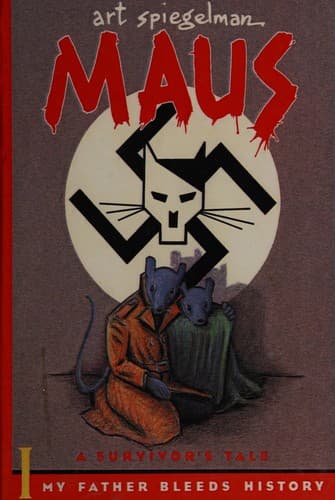
Maus (1986)
About This Book
A cartoonist interviews his father about surviving the Holocaust, depicting Jews as mice, Nazis as cats, Poles as pigs, and Americans as dogs, and the result is both one of the most powerful depictions of the Holocaust ever created and one of the most honest portraits of a difficult parent-child relationship in any medium. Art Spiegelman proved that comics could address the most serious subjects in literature.
Why It's a Classic
Spiegelman's animal metaphor does something paradoxical: by abstracting the victims and perpetrators into mice and cats, he makes the horror more rather than less accessible, because the simple, expressive drawings bypass the defenses that realistic photography can trigger and reach an emotional register that is almost childlike in its directness. The dual narrative, alternating between Vladek's wartime survival and Art's present-day struggle to record his father's story, creates a meditation on how trauma transmits across generations: Vladek's experiences made him the difficult, miserly, prejudiced man Art grew up with, and Art's guilt about resenting his father while asking him to relive his worst memories is handled with painful honesty. The formal innovations, including a chapter called 'Prisoner on the Hell Planet' drawn in an expressionist style that ruptures the animal metaphor, demonstrate that Spiegelman was not merely telling a story but interrogating the very possibility of representing the Holocaust. The book won a special Pulitzer Prize in 1992, the first graphic novel to receive a Pulitzer in any category.
Fun Fact
Spiegelman serialized Maus in his avant-garde comics magazine RAW from 1980 to 1991. The Pulitzer board created a special category for the book because it could not decide whether to classify it as fiction or nonfiction. When the book was banned from a school district in Tennessee in 2022, it immediately became the number one bestseller on Amazon. Vladek Spiegelman died in 1982, before the second volume was completed, and his absence haunts the later chapters. Spiegelman has said that the animal metaphor was partly inspired by Nazi propaganda that depicted Jews as vermin, and that his use of it was a deliberate act of reclamation.
Parent Note
The book depicts the Holocaust in detail, including forced labor, starvation, gas chambers, the selection process at Auschwitz, and the murder of children. There is nudity (mice depicted without clothing), a suicide, and frank depictions of family dysfunction. The animal metaphor makes the violence accessible to younger readers but the content itself is genuinely harrowing. Language includes some profanity. The book is divided into two volumes totaling roughly 300 pages. Suitable for readers fourteen and up, though the Holocaust content is intense at any age. One of the most important works in any medium to address the Holocaust.
Quick Facts
- Year
- 1986
- Type
- 📚 Book
- Category
- Graphic Novels / Comics
- Age Group
- Adults (Ages 18+)