Persepolis (2000)
About This Book
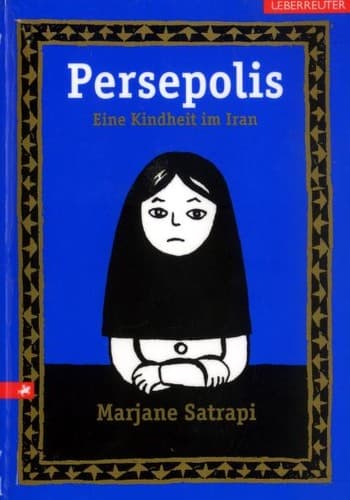
Marjane Satrapi tells the story of growing up in Tehran during the Islamic Revolution and the Iran-Iraq War, from a childhood of protest and punk rock under the Shah's fall to adolescence in Vienna as an exile, and back to Iran as a young adult trying to reconcile her Western-influenced identity with her Iranian heritage. The stark black and white art strips away everything except the emotional essentials.
Why It's a Classic
Satrapi's decision to tell a story of revolution, war, and exile in simple black and white drawings was a formal choice of profound effectiveness: the clean lines and flat shapes force the reader to fill in the emotional complexity that realistic art would provide automatically, creating an engagement that is active rather than passive. Her childhood perspective on the Revolution is invaluable because it captures the excitement, confusion, and terror of political upheaval without the retrospective tidiness of adult analysis: young Marjane wants to be a revolutionary and a prophet, wears a punk bracelet under her veil, and processes her uncle's execution with the incomprehension of a child who has not yet learned to separate personal loss from political conviction. The memoir's honesty about exile is equally powerful: Satrapi's years in Vienna are marked by loneliness, failed relationships, and a drug-fueled depression that is presented without self-pity. The two-volume structure (Persepolis and Persepolis 2) creates a complete portrait of a woman caught between cultures, between political ideologies, and between the person her family wants her to be and the person she is becoming.
Fun Fact
Satrapi wrote and drew the books in French while living in Paris, and they were originally published by the French publisher L'Association in four volumes between 2000 and 2003 (combined into two volumes for the English edition). The animated film adaptation, co-directed by Satrapi and Vincent Paronnaud, was nominated for the Academy Award for Best Animated Feature in 2007. The Iranian government condemned the film and pressured the Thai government to cancel its screening at the Bangkok International Film Festival. Satrapi has said that she used black and white to universalize the story: 'The moment you give color, you give nationality. I wanted to make it clear that this could happen anywhere.'
Parent Note
The memoir depicts war (the Iran-Iraq War, including bombing raids on Tehran), political executions, torture, the suppression of women's rights under the Islamic Republic, adolescent drug use and depression, a suicide attempt, and the trauma of exile. The art style is not graphic in the conventional sense, but the events described are often harrowing. There is brief sexual content and some strong language. The two volumes total roughly 340 pages. Suitable for readers fourteen and up. An essential graphic memoir and one of the most important works about the Iranian Revolution.
Quick Facts
- Year
- 2000
- Type
- 📚 Book
- Category
- Graphic Novels / Comics
- Age Group
- Adults (Ages 18+)