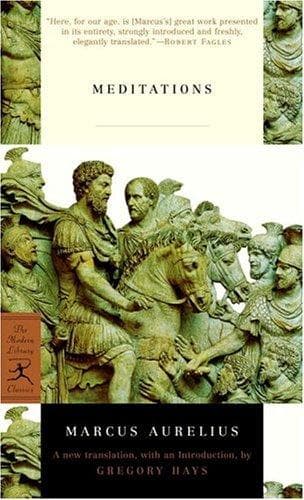
Meditations (180)
About This Book
A Roman emperor writes a private journal that was never intended for publication, recording his attempts to apply Stoic philosophy to the daily challenges of ruling an empire, managing his own anger and grief, and accepting the inevitability of death. Marcus Aurelius wrote the most practical philosophy book ever composed, a text that reads less like a treatise and more like a conversation with someone working through the same anxieties you have.
Why It's a Classic
The Meditations is unique in philosophical literature because it was written for an audience of one: Marcus Aurelius was talking to himself, and the result is a text that is remarkably free of the performance and abstraction that characterize most philosophical writing. His concerns, how to remain calm under pressure, how to deal with difficult people, how to accept what you cannot change, how to remember that you will die, are universal, and his advice is concrete enough to be applied directly. The Stoic framework, which teaches that you can control your responses even when you cannot control events, has influenced cognitive behavioral therapy and is the philosophical basis for much of the modern self-help movement. The most striking quality of the Meditations is its honesty: Marcus does not present himself as a sage who has mastered his emotions but as a man who struggles daily and must remind himself, again and again, of the principles he believes in. This vulnerability makes the text feel like a friend's journal rather than a lecture.
Fun Fact
Marcus Aurelius wrote the Meditations during the last decade of his life, much of it while on military campaigns along the Danube frontier. The text was written in Greek, the language of philosophy, rather than Latin, the language of Roman administration. It has no title; 'Meditations' was assigned by later editors. The text was almost lost to history and survived in a single manuscript. Marcus Aurelius was the last of the 'Five Good Emperors' of Rome, and his death in 180 CE is often cited as the beginning of the Roman Empire's decline. His son and successor, Commodus, was the opposite of everything Marcus advocated, and their relationship (depicted fictionally in the film Gladiator) has become a symbol of philosophy's inability to prevent bad outcomes.
Parent Note
The text contains reflections on death, suffering, the shortness of life, and the indifference of the universe. Marcus discusses war, plague, and personal loss with a Stoic equanimity that some readers find inspiring and others find cold. There is no graphic content, violence, or sexual material. The text is short (roughly 170 pages) and can be read in any order, as it was not structured as a continuous argument. Translation matters: the Gregory Hays translation is the most readable modern version; the Robin Hard translation is also excellent. Suitable for readers fourteen and up. One of the most widely read philosophical texts in the world.
Quick Facts
- Year
- 180
- Type
- 📚 Book
- Category
- Philosophy & Ideas
- Age Group
- Adults (Ages 18+)