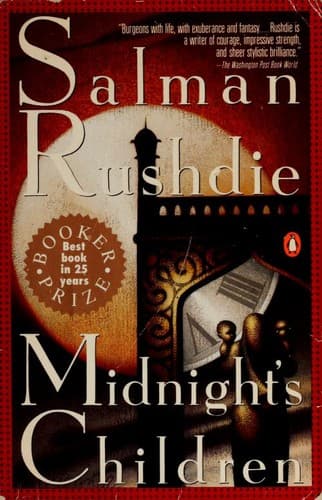
Midnight's Children (1981)
About This Book
Saleem Sinai is born at the exact moment of India's independence, midnight on August 15, 1947, and discovers that all 1,001 children born in that first hour share telepathic powers, each child a symbol of the new nation's possibilities and its dangers. Salman Rushdie wrote the novel that reinvented the postcolonial novel, a kaleidoscopic, funny, tragic, and impossibly ambitious reimagining of India's first decades told by an unreliable narrator whose body is literally crumbling as he writes.
Why It's a Classic
Rushdie created a new kind of English prose for Midnight's Children: sprawling, digressive, polyphonic, flavored with Hindi and Urdu, packed with puns, allusions, and Bombay street slang, it moves at the speed of oral storytelling and creates a linguistic texture that is itself an argument about India's multiplicity. Saleem's narrative is structured around the conceit that his personal history and India's national history are identical: his birth coincides with independence, his family's dramas parallel the country's political crises, and his body deteriorates as the nation's democratic ideals are eroded, creating a metaphor so sustained that it transforms autobiography into national epic. The novel's magical realism draws on Indian storytelling traditions rather than Latin American models, and its political satire, particularly of the Emergency period under Indira Gandhi (thinly disguised as 'The Widow'), is both hilarious and devastating. The novel won the Booker Prize in 1981 and was later awarded the 'Booker of Bookers' (best Booker winner of the prize's first twenty five years) and the 'Best of the Booker' (best winner of the first forty years).
Fun Fact
Rushdie has acknowledged that the novel contains deliberate factual errors (wrong dates, misattributed events) because Saleem is an unreliable narrator whose memory is flawed, and these errors are part of the novel's argument that history is always a construction. The novel's political content made Rushdie a controversial figure in India even before the Satanic Verses controversy: Indira Gandhi sued him for a single sentence in the novel (she won and the sentence was removed from subsequent editions). The novel draws on Rushdie's own childhood in Bombay (now Mumbai), and the Methwold's Estate where Saleem grows up is based on a real housing development. The 1,001 midnight's children echo the 1,001 nights of Scheherazade, a connection Rushdie has acknowledged.
Parent Note
The novel contains political violence (including the Indo-Pakistani wars, the Bangladesh War, and the Emergency), forced sterilization (a historical atrocity committed during the Emergency), sexual content, and the physical deterioration of the narrator's body described in detail. The prose is dense, allusive, and deliberately overwhelming, which can be challenging for readers unfamiliar with Indian history and culture. The novel is roughly 530 pages. Historical context about India's independence, the Partition, and subsequent political events enhances the reading experience significantly. Suitable for readers seventeen and up. One of the defining novels of postcolonial literature.
Quick Facts
- Year
- 1981
- Type
- 📚 Book
- Category
- Modern & Contemporary Literature
- Age Group
- Adults (Ages 18+)