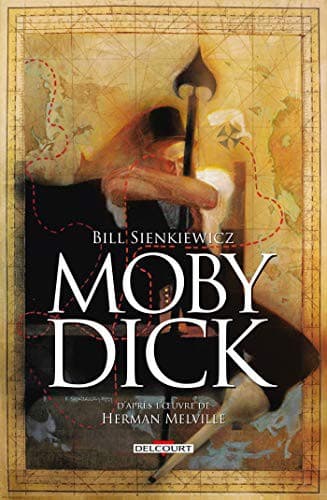
Moby-Dick (1851)
About This Book
A young man ships out on a whaling vessel commanded by Captain Ahab, a monomaniac who has sacrificed everything to hunt the great white whale that took his leg, and the voyage becomes a meditation on obsession, nature, God, race, and the limits of human knowledge. Herman Melville wrote a novel so vast and strange that it failed on publication and was not recognized as America's greatest literary achievement until the 1920s.
Why It's a Classic
Melville embedded within his whaling adventure a philosophical encyclopedia that ranges from cetology to theology, from Shakespeare to the physics of rope, and the result is a book that contains multitudes in the Whitman sense: every reading reveals new layers. Ahab is one of literature's supreme creations, a figure of Shakespearean grandeur whose speeches crackle with the energy of a mind consumed by a single idea, and Melville's refusal to reduce him to mere madness is what gives the novel its tragic power. The relationship between Ishmael and Queequeg, the Polynesian harpooner, is one of the most tender and radical friendships in nineteenth century literature, a genuine interracial partnership presented without condescension decades before the Civil War. The chapters on whaling technique, often cited by reluctant readers as obstacles, are actually Melville's way of insisting that the physical world matters as much as the symbolic one. The final chase sequence is one of the greatest action set pieces in literature.
Fun Fact
The novel sold only 3,715 copies during Melville's lifetime, and by the time he died in 1891, it was essentially forgotten. A revival in the 1920s, led by critics who recognized Melville as a precursor to modernism, transformed the novel's reputation entirely. Melville dedicated the book to Nathaniel Hawthorne, whose friendship was one of the most intense literary relationships in American history. The opening line, 'Call me Ishmael,' is one of the most famous in literature, though Melville considered and rejected several alternatives. A real albino sperm whale named Mocha Dick, known for attacking whaling ships in the Pacific, was one of Melville's inspirations.
Parent Note
The novel contains graphic descriptions of whale hunting and butchering, violence against animals and humans, a shipwreck with mass death, and philosophical passages that engage with questions of God, evil, and meaninglessness. The prose style is dense and allusive, drawing on the Bible, Shakespeare, and classical literature. Some racial language reflects nineteenth century attitudes. The novel's length (roughly 600 pages) and digressions require patience. Best for readers seventeen and up with some tolerance for challenging prose. The Penguin Classics or Norton Critical editions are recommended for their annotations.
Quick Facts
- Year
- 1851
- Type
- 📚 Book
- Category
- Adventure
- Age Group
- Adults (Ages 18+)