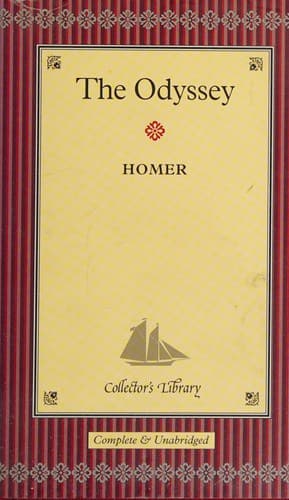
The Odyssey (-700)
About This Book
After fighting at Troy for ten years, Odysseus spends another ten trying to get home to his wife and son, encountering a one eyed giant, a witch who turns men into pigs, the land of the dead, singing monsters, and a sea god who wants him drowned. Homer composed the foundational adventure story of Western civilization, and three thousand years later, every journey home in fiction still echoes this one.
Why It's a Classic
Homer invented the idea that the journey is more important than the destination, and each of Odysseus' encounters functions as both a thrilling adventure and a test of the qualities needed to survive: cunning, patience, self-restraint, and the ability to tell a good story. The poem's structure, which begins in medias res and uses flashbacks narrated by Odysseus himself, established storytelling techniques that novelists and filmmakers still rely on. Penelope, waiting in Ithaca and fending off a hundred suitors with her own brand of cleverness, is one of literature's great characters, whose intelligence matches her husband's in ways that ancient audiences recognized even if modern adaptations sometimes forget. The Cyclops episode, in which Odysseus escapes by calling himself 'Nobody' so the blinded giant cannot name his attacker, is the prototype for every clever trickster scene in fiction. The homecoming, when Odysseus returns disguised as a beggar and is recognized only by his old dog, remains one of the most emotionally devastating moments in all of literature.
Fun Fact
The poem was composed orally, probably by generations of poets before being written down around 700 BCE, and the repeated phrases ('rosy fingered dawn,' 'wine dark sea') were memory aids that helped bards recite the 12,110 line poem from memory. The word 'odyssey' entered English directly from the title and now means any long, eventful journey. Emily Wilson's 2017 translation was the first English translation by a woman, and its contemporary, accessible style introduced the poem to millions of new readers. The opening word of the Greek text is 'andra,' meaning 'man,' setting up the poem's central question: what kind of man will Odysseus be when he finally gets home?
Parent Note
The poem contains violence including battles, killings, and the mass slaughter of the suitors at the climax. There are episodes involving cannibalism (the Cyclops), witchcraft, seduction, and descent into the underworld. Odysseus is unfaithful to Penelope with both Circe and Calypso (presented matter of factly in the ancient context). The treatment of female characters and enslaved people reflects ancient Greek values. Translation choice matters enormously for accessibility. Emily Wilson's (2017) or Robert Fagles' (1996) translations are the most readable for modern audiences. Suitable for teens and up.
Quick Facts
- Year
- -700
- Type
- 📚 Book
- Category
- Adventure
- Age Group
- Adults (Ages 18+)