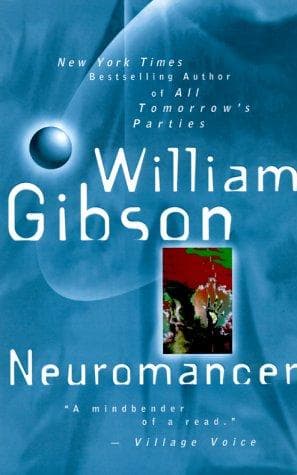
Neuromancer (1984)
About This Book
A washed up computer hacker named Case is recruited by a mysterious employer to pull off the ultimate hack, a job that takes him from the urban sprawl of the Chiba City black market to an orbital playground of the ultra-rich, and the virtual reality he jacks into feels more alive than the physical world he inhabits. William Gibson wrote the novel that invented cyberpunk and predicted the internet, virtual reality, and the digital economy decades before they existed.
Why It's a Classic
Gibson coined the word 'cyberspace' and described it as 'a consensual hallucination experienced daily by billions,' a phrase written in 1984 that reads like a description of the modern internet. The novel's vision of a future dominated by multinational corporations, digital addiction, body modification, and a permanent underclass living in the ruins of industrial civilization has proved so prescient that it no longer reads as science fiction but as slightly exaggerated reportage. Case is an anti-hero in the truest sense: a junkie and a thief whose only virtue is his skill, and Gibson refuses to sentimentalize him or his world. The prose style, dense with neologisms and sensory overload, mirrors the information-saturated environment it describes, and the novel's refusal to slow down and explain itself was deliberately disorienting, forcing readers to assemble meaning from fragments the way a hacker assembles data. Molly Millions, the razorgirl with retractable blades beneath her fingernails and surgically implanted mirror shades, became one of science fiction's most iconic characters.
Fun Fact
Gibson wrote the novel on a manual typewriter because he knew almost nothing about computers, which he has called liberating because it allowed him to imagine cyberspace without being constrained by actual technology. He has said that watching kids playing early arcade games in Vancouver gave him the idea: their body language suggested they wanted to be inside the machine. The novel swept the Hugo, Nebula, and Philip K. Dick Awards, the first novel to win all three. Gibson later admitted that he saw the Apple Macintosh for the first time while writing the book and was so intimidated by it that he thought his fictional vision of computing might already be obsolete.
Parent Note
The novel contains drug use (central to the plot and protagonist's character), graphic violence, sexual content, body modification, and a noir atmosphere of moral ambiguity. The prose style is deliberately challenging, with unfamiliar terminology and a fast pace that assumes the reader can keep up. Language is strong. The vision of the future is bleak and corporate-dominated. Suitable for readers sixteen and up with some experience reading science fiction. An essential novel for understanding digital culture, though readers unfamiliar with 1980s computing culture may miss some references.
Quick Facts
- Year
- 1984
- Type
- 📚 Book
- Category
- Fantasy / Sci-Fi
- Age Group
- Adults (Ages 18+)