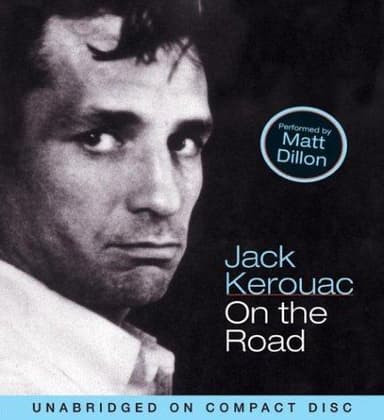
On the Road (1957)
About This Book
Sal Paradise and Dean Moriarty crisscross America in a series of frantic, jazz-fueled road trips, chasing an ecstatic experience that always seems to be just around the next bend, in the next city, with the next woman, and the novel pulses with the energy of young men who believe that movement is meaning. Jack Kerouac wrote the Beat Generation's bible, a book that made an entire generation want to hit the highway and find out what was on the other side.
Why It's a Classic
Kerouac's prose style, which he called 'spontaneous prose' and which was influenced by jazz improvisation, represents one of the great experiments in American writing: the sentences tumble forward with the breathless energy of a saxophone solo, and the rhythm of the language enacts the restlessness it describes. Dean Moriarty (based on Neal Cassady) is one of the most magnetic and destructive characters in American fiction: a man of limitless energy and zero responsibility whose charisma pulls everyone into his orbit and whose trail of abandoned wives, children, and friends reveals the cost of freedom pursued without conscience. The America the novel describes, a landscape of truck stops, jazz clubs, migrant camps, and open highways, is both romantically beautiful and honestly depicted as a place of poverty, racial inequality, and human need. The novel's influence on American culture extends far beyond literature: it helped create the youth culture of the 1960s, the idea of the road trip as a rite of passage, and the notion that authenticity is found not in institutions but in movement and experience.
Fun Fact
Kerouac wrote the first draft in three weeks in April 1951, typing on a continuous 120-foot scroll of teletype paper taped together so he would not have to stop to change sheets, though the legend that the novel was written in a single spontaneous burst overstates the case: Kerouac revised extensively before publication. The novel was rejected by several publishers and not published until 1957, six years after the initial draft. Neal Cassady, the model for Dean Moriarty, was himself a legendary figure of the Beat and hippie movements; he later drove the bus 'Furthur' for Ken Kesey's Merry Pranksters. The original scroll sold at auction in 2001 for $2.43 million. Truman Capote famously dismissed Kerouac's prose: 'That's not writing, that's typing.'
Parent Note
The novel contains heavy drug use (marijuana, benzedrine), alcohol consumption, sexual content (including promiscuity and references to prostitution), reckless driving, petty theft, and the abandonment of women and children by the male protagonists. The treatment of women and minorities reflects the attitudes of the 1950s Beat culture, which celebrated male freedom at the expense of the women left behind. The romanticization of irresponsibility is part of the novel's appeal and its limitation. The language is mild. The novel is roughly 300 pages and highly readable. Suitable for readers sixteen and up. Essential reading for understanding American counterculture.
Quick Facts
- Year
- 1957
- Type
- 📚 Book
- Category
- Modern & Contemporary Literature
- Age Group
- Adults (Ages 18+)