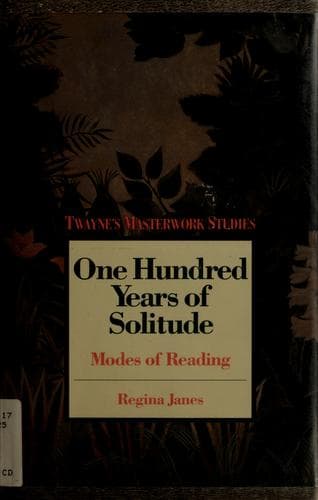
One Hundred Years of Solitude (1967)
About This Book
Seven generations of the Buendía family rise and fall in the mythical Colombian town of Macondo, and the story encompasses civil wars, banana plantations, plagues of insomnia and forgetting, flying carpets, women ascending to heaven while hanging laundry, and a family tree so tangled with repetition that the same names and the same mistakes recur across a century until the final Buendía deciphers the prophecy that has been encoding the family's fate all along. Gabriel García Márquez wrote the novel that invented magical realism and that reads like the fever dream of an entire continent.
Why It's a Classic
García Márquez's achievement was creating a narrative mode in which the miraculous and the mundane exist on the same plane: a woman ascends to heaven, a man is followed everywhere by yellow butterflies, it rains for four years, and these events are narrated with the same matter-of-fact precision as the planting of crops and the start of a war. This technique, magical realism, became the dominant mode of Latin American fiction and influenced writers worldwide. The novel is also a compressed history of Colombia (and, by extension, Latin America), encoding the violence of civil wars, the exploitation of banana companies backed by the U.S. military, and the cyclical nature of political power in a continent where progress is always undermined by the return of old patterns. The Buendía family's tragedy is that they are doomed to repeat themselves, and the novel's structure (circular, repetitive, with names and events echoing across generations) enacts this doom formally. The final sentence, in which the reader discovers that the novel itself is the manuscript that the last Buendía is reading, is one of the great metafictional moments in literature.
Fun Fact
García Márquez sold his car to support his family while writing the novel and reportedly told his wife, Mercedes, not to bother him 'even if the house catches fire.' He mailed the manuscript to his publisher in Buenos Aires and did not have enough money for postage for the entire package; he sent half and then had to sell his wife's hairdryer and heater to mail the rest. The novel sold over fifty million copies and has been translated into more than forty languages. García Márquez won the Nobel Prize in Literature in 1982. He has said that the novel's opening sentence ('Many years later, as he faced the firing squad, Colonel Aureliano Buendía was to remember that distant afternoon when his father took him to discover ice') took him years to perfect.
Parent Note
The novel contains violence (civil war, execution, massacre), sexual content (including incest, which is a central theme of the family's self-destruction), death, mental illness, and a morally complex universe in which cruelty and beauty coexist without judgment. The magical elements may be disorienting for readers accustomed to realist fiction. The large cast of characters, many sharing the same names, requires attentive reading (a family tree is usually included). The novel is roughly 420 pages. The Gregory Rabassa translation is considered definitive. Suitable for readers sixteen and up. One of the most important novels of the twentieth century and the foundational text of magical realism.
Quick Facts
- Year
- 1967
- Type
- 📚 Book
- Category
- Modern & Contemporary Literature
- Age Group
- Adults (Ages 18+)