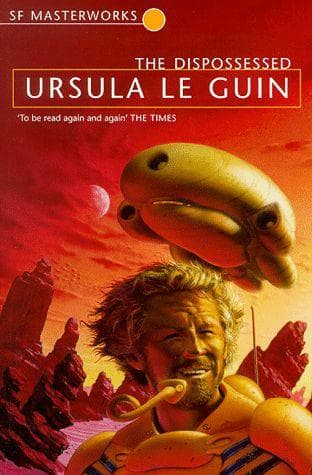
The Dispossessed (1974)
About This Book
A brilliant physicist from an anarchist society on a barren moon travels to the wealthy, capitalist planet it orbits, and alternating chapters follow his life in both worlds, revealing the compromises and failures of each system. Ursula K. Le Guin subtitled the novel 'An Ambiguous Utopia' and spent 340 pages demonstrating exactly why the ambiguity matters.
Why It's a Classic
Le Guin accomplished something rare in political fiction: she presented two contrasting societies with genuine fairness, showing the failures of both anarchism and capitalism without declaring either one the winner. Shevek's anarchist home of Anarres is free from government, private property, and formal hierarchy, but it has developed its own forms of social coercion, intellectual suppression, and conformist pressure that are all the more insidious for being unofficial. The capitalist planet Urras is rich, beautiful, and intellectually vibrant, but its wealth is built on exploitation, and its freedom is available only to those who can afford it. Shevek himself is a genuinely great literary creation: a physicist whose work on temporal theory mirrors the novel's own structure (chapters alternate between past and present, between the two worlds), and whose personal journey embodies the question of whether individual genius can transcend the limitations of any social system. The novel's refusal to endorse a simple answer is its greatest strength.
Fun Fact
Le Guin wrote the novel during a period of political ferment in the 1970s, drawing on the work of anarchist thinkers like Peter Kropotkin and Paul Goodman. She has said that the anarchist society of Anarres was her attempt to imagine what a functioning anarchism might actually look like, including its inevitable failures. The novel won both the Hugo and Nebula Awards. Le Guin's invented language for the Anarresti, in which possessive pronouns are avoided because no one 'owns' anything, is a subtle demonstration of how language shapes thought, echoing the Sapir-Whorf hypothesis.
Parent Note
The novel contains scenes of political repression, a massacre of protesters, imprisonment, sexual content (including a scene of attempted sexual assault), and discussions of revolutionary politics. The intellectual demands are significant: the novel engages seriously with political philosophy, physics, and theories of language. There is mild language. The alternating timeline structure requires attentive reading. Suitable for readers sixteen and up with an interest in political ideas. An excellent companion to 1984 and Brave New World for discussions about different approaches to imagining alternative societies.
Quick Facts
- Year
- 1974
- Type
- 📚 Book
- Category
- Fantasy / Sci-Fi
- Age Group
- Adults (Ages 18+)