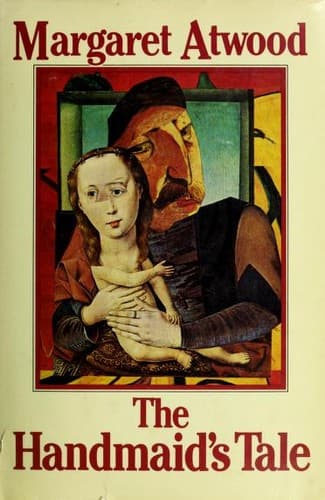
The Handmaid's Tale (1985)
About This Book
In the Republic of Gilead, a theocratic regime that has replaced the United States, women are stripped of all rights and fertile women are forced to bear children for the ruling class in a ritualized form of state-sanctioned rape. Offred, a handmaid assigned to a Commander's household, narrates her captivity with a voice that shifts between numbness, fury, dark humor, and desperate longing for the life she lost. Margaret Atwood wrote a dystopia built entirely from things that have actually happened somewhere in the world.
Why It's a Classic
Atwood's power lies in her restraint: she has said that she included nothing in the novel that had not already occurred in some society at some point in history, and this grounding in reality is what makes Gilead so chilling. Offred's narration is remarkable for what it reveals about the psychology of survival under totalitarianism: she is not a heroic resistance fighter but a woman trying to stay alive, and her small acts of rebellion (a glance, a hidden word, a memory) are presented as genuinely courageous precisely because they risk everything. The regime's use of biblical language to justify its oppression is Atwood's most incisive observation: the Ceremony, in which the Commander's Wife holds the Handmaid down during the act of conception, is derived from the story of Rachel and Bilhah in Genesis, and the novel demonstrates how scripture can be weaponized against the people it claims to protect. The ending, which shifts to an academic conference centuries later where scholars discuss Offred's testimony with clinical detachment, is one of the most unsettling framing devices in modern fiction.
Fun Fact
Atwood began writing the novel in West Berlin in 1984, while the Berlin Wall still stood, and the experience of living in a divided city surrounded by authoritarian surveillance influenced the novel's atmosphere. She insists on calling her work 'speculative fiction' rather than science fiction, because everything in it is based on documented historical precedent. The novel was adapted into a Hulu television series in 2017 that extended the story beyond the novel and won numerous Emmy Awards. Atwood published a sequel, 'The Testaments,' in 2019, thirty-four years after the original, and it won the Booker Prize (shared with Bernardine Evaristo's 'Girl, Woman, Other').
Parent Note
The novel depicts state-sanctioned sexual violence (the Ceremony), public executions, forced surrogacy, the complete subjugation of women, torture, and the violent overthrow of democratic government. The sexual content is not explicit but is deeply disturbing in its institutional context. Themes of religious extremism, reproductive control, and the erosion of civil liberties are central. Language is moderate. The novel is accessible and relatively short (roughly 300 pages). Suitable for readers sixteen and up. The novel is widely taught in high schools and is essential reading for discussions about women's rights, theocracy, and political regression.
Quick Facts
- Year
- 1985
- Type
- 📚 Book
- Category
- Fantasy / Sci-Fi
- Age Group
- Adults (Ages 18+)