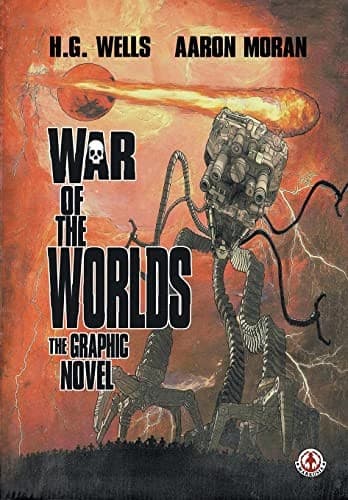
The War of the Worlds (1898)
About This Book
Martians land in the English countryside and proceed to devastate Victorian civilization with heat rays and tripod war machines, and an unnamed narrator flees across a landscape of burning cities and panicking crowds, witnessing the total collapse of the society that believed itself the pinnacle of progress. H.G. Wells invented the alien invasion story and used it to force the British Empire to imagine what colonization feels like from the other side.
Why It's a Classic
Wells deliberately structured the novel as an inversion of British imperialism: the Martians treat humanity exactly as the British treated the peoples they colonized, arriving with superior technology, viewing the natives as inferior, and exploiting resources without moral consideration. This allegory gives the novel a political edge that elevates it above mere adventure. The narrator's journey through a destroyed England, from initial curiosity to abject terror to near-madness, is one of the great survival narratives in fiction, and Wells' descriptions of the Martian machines striding across the landscape created images so powerful that they have defined how science fiction visualizes alien invasion ever since. The ending, in which the Martians are defeated not by human ingenuity but by bacteria, is both a plot twist and a philosophical statement: humanity is saved by the smallest and most humble forms of life, a fact that cuts human pretensions down to size.
Fun Fact
Orson Welles' 1938 radio broadcast adaptation, presented as a series of fake news bulletins, reportedly caused widespread panic among listeners who believed a real Martian invasion was underway, though the extent of the panic has been debated by historians. Wells wrote the novel partly in response to an essay speculating about life on Mars, and his Martians' physical description (large brains, atrophied bodies) reflects Victorian anxieties about the direction of human evolution. The novel has been adapted into films multiple times, most notably by Steven Spielberg in 2005. Wells wrote the novel in Woking, Surrey, and a sculpture of a Martian tripod now stands in the town center.
Parent Note
The novel contains descriptions of mass destruction, death by heat ray (people are incinerated), the collapse of civil society, and a scene in which the narrator kills a man in self-defense. The Martians harvest human blood for sustenance, which is described with clinical horror. The violence is not graphically described by modern standards but the scale of destruction is conveyed effectively. No sexual content or strong language. The prose is Victorian but readable. Suitable for readers thirteen and up. An excellent introduction to classic science fiction and a fascinating document of Victorian anxieties about technology and empire.
Quick Facts
- Year
- 1898
- Type
- 📚 Book
- Category
- Fantasy / Sci-Fi
- Age Group
- Adults (Ages 18+)