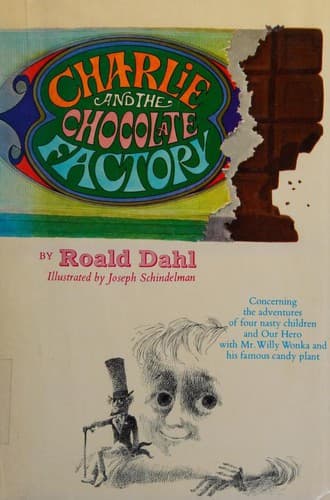
Charlie and the Chocolate Factory (1964)
About This Book
Charlie Bucket, the poorest boy in town, finds one of five Golden Tickets hidden in Wonka chocolate bars and wins a tour of the most extraordinary, secretive candy factory on Earth. Inside, Willy Wonka's inventions defy physics and good taste in equal measure while the four other children meet fates that are both hilarious and horrifying. The book crackles with anarchic energy and a gleeful willingness to punish greed, gluttony, and brattiness in the most inventive ways imaginable.
Why It's a Classic
Roald Dahl had a rare gift for writing from the child's perspective without condescending, and this book is his most fully realized expression of that talent. Wonka's factory functions as a moral universe where the punishments fit the crimes with poetic precision: Augustus Gloop's gluttony sends him up the chocolate pipe, Violet Beauregarde's competitive gum-chewing turns her into a blueberry. Dahl's prose is lean, vivid, and wickedly funny, with a rhythm that makes it irresistible to read aloud. The Oompa-Loompas' moralizing songs walk a perfect line between genuine warning and satirical excess. Charlie himself is an unusual protagonist because his virtue is entirely passive; he wins by simply not being awful, which is either a gentle lesson in decency or a sly commentary on how the world actually rewards luck over merit.
Fun Fact
Dahl originally wrote a version of the story featuring the Oompa-Loompas as African pygmies, which was revised after criticism in the 1970s. He worked in chocolate testing as a schoolboy, and the experience directly inspired Wonka's factory. Dahl wrote the book's first draft in a single sitting but spent months revising it, and his agent initially told him it was his worst work.
Parent Note
The punishments the children face are darkly comic and occasionally intense; Augustus Gloop is sucked up a pipe, Violet swells into a giant blueberry, and Veruca Salt is sent down a garbage chute. Dahl's humor has a mean streak that some sensitive children find unsettling. For most kids ages 7 and up, though, the dark comedy is part of the appeal.
Quick Facts
- Year
- 1964
- Type
- 📚 Book
- Category
- Fantasy / Sci-Fi
- Age Group
- Kids (Ages 7–10)