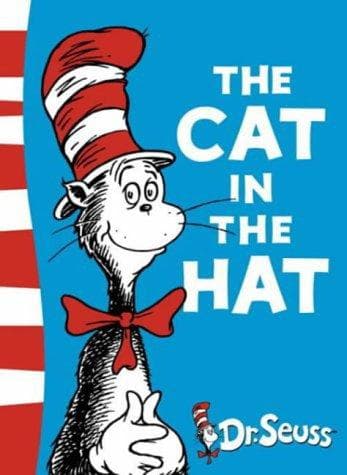
The Cat in the Hat (1957)
About This Book
Two bored children stuck inside on a rainy day get an uninvited visit from a tall cat in a striped hat who proceeds to wreck their house with increasingly chaotic games, aided by Thing One and Thing Two. The goldfish protests, the children stare, and the mess grows to impossible proportions before the Cat cleans it all up seconds before Mother walks in. It is anarchy between covers, and every child recognizes the thrill.
Why It's a Classic
Seuss wrote The Cat in the Hat as a direct response to Rudolf Flesch's 1955 polemic "Why Johnny Can't Read," which attacked the dullness of Dick and Jane primers. Using a limited vocabulary of roughly 220 words, Seuss proved that controlled vocabulary did not have to mean controlled fun. The Cat himself is one of literature's great trickster figures, in the tradition of Loki and Coyote, bringing chaos that is terrifying and liberating in equal measure. The tension between the rule-following fish and the anarchic Cat gives the book a genuine moral complexity: the children never decide whether to stop the Cat, and that ambiguity is part of the book's lasting power. Seuss's anapestic tetrameter drives the text forward with relentless momentum, making the reading experience feel like a ride you cannot get off. The book did not merely entertain; it restructured how America taught children to read, launching the Beginner Books series that became the foundation of early literacy for generations.
Fun Fact
Seuss spent over a year writing The Cat in the Hat, struggling to create a story from the approved word list for first graders. He later said he wrote it by scanning the list for two words that rhymed and could serve as a title; "cat" and "hat" were the first pair he found. The book sold over a million copies in its first three years, and its success directly led to the founding of Beginner Books, the Random House imprint that Seuss co-founded.
Parent Note
The Cat's behavior is deliberately transgressive: he enters uninvited, makes an enormous mess, and operates without any adult supervision. This is exactly why children love it, and exactly why some parents feel ambivalent. The mess does get cleaned up, and no real consequences occur. It works best for ages three through seven and is a strong early independent reading book for kids who are ready.
Quick Facts
- Year
- 1957
- Type
- 📚 Book
- Category
- Humor
- Age Group
- Little Kids (Ages 3–6)