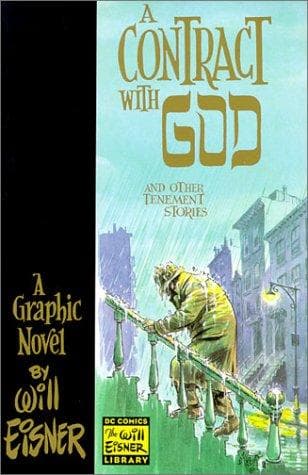
A Contract with God (1978)
About This Book
Four interconnected stories set in a 1930s Bronx tenement building explore the lives of Jewish immigrants and their neighbors: a pious man who loses his faith after the death of his adopted daughter, a street singer who gains and loses everything, a predatory superintendent who meets his match, and a group of summer vacationers whose holiday reveals their pretensions and desires. Will Eisner coined the term 'graphic novel' with this pioneering work.
Why It's a Classic
Eisner, who had been creating comics since the 1930s and is considered one of the founding fathers of the American comic book, returned to the medium at age sixty-one with a work that deliberately positioned itself as literature rather than entertainment. His expressionistic ink wash drawings, which use rain, shadow, and architectural detail to create an atmosphere of urban melancholy, established a visual vocabulary for serious graphic storytelling that subsequent artists have drawn on for decades. The first story, 'A Contract with God,' in which Frimme Hersh, a devout man, challenges God after the death of his daughter and discovers that his covenant with the divine has no binding power, is a meditation on faith and suffering that connects the Jewish immigrant experience to the deepest questions of theodicy. Eisner's decision to call the work a 'graphic novel' was partly a marketing strategy (he wanted bookstores rather than comic shops to stock it), but the term stuck and transformed the industry by giving creators and readers a vocabulary for comics that aspire to literary seriousness.
Fun Fact
Eisner actually based the stories on his own experiences growing up in a Bronx tenement in the 1930s, and the character of Frimme Hersh's grief over a child's death was informed by the death of Eisner's own daughter, Alice, from leukemia in 1970. While Eisner is credited with popularizing the term 'graphic novel,' the term had been used occasionally before (notably by Richard Kyle in 1964). The Eisner Awards, the comic book industry's most prestigious prizes, are named in his honor. Eisner continued producing graphic novels until his death in 2005 at age eighty-seven, and his later works (including 'The Building,' 'Dropsie Avenue,' and 'The Plot') are considered among his finest achievements.
Parent Note
The stories contain sexual content (including a scene of sexual manipulation), religious crisis, death of a child, poverty, anti-Semitism, and the struggles of immigrant life in Depression-era New York. The sexual content is depicted in Eisner's expressionistic style, which is suggestive rather than explicit. One story features a predatory character in a position of power. The themes are adult and the emotional register is often melancholy. The book is roughly 180 pages. Suitable for readers sixteen and up. A foundational work of the graphic novel form.
Quick Facts
- Year
- 1978
- Type
- 📚 Book
- Category
- Graphic Novels / Comics
- Age Group
- Adults (Ages 18+)