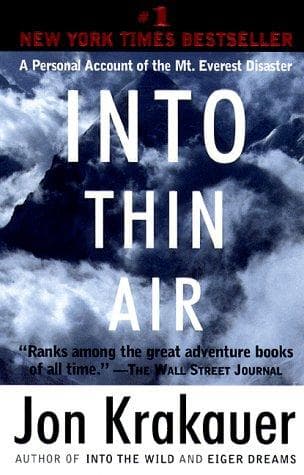
Into Thin Air (1997)
About This Book
Jon Krakauer, a journalist assigned to write about the commercialization of Everest, was climbing the mountain on May 10, 1996, when a sudden storm killed eight people, and his account of the disaster is both a gripping survival narrative and a meditation on the hubris of believing you can buy your way up the world's tallest peak. The book will make you cold, breathless, and grateful to be at sea level.
Why It's a Classic
Krakauer brought two rare qualities to the story: the climbing expertise to understand exactly what went wrong technically and the journalistic skill to reconstruct the disaster from multiple perspectives while acknowledging his own compromised memory and possible culpability. The book's power comes from its accumulation of small decisions, each one rational in isolation, that combine into catastrophe: the late summit times, the depleted oxygen supplies, the failure to turn back when conditions deteriorated. The portraits of the guides, particularly Rob Hall and Scott Fischer, are drawn with empathy and honesty, showing experienced mountaineers who made mistakes under pressure and paid for them with their lives. Krakauer's own guilt over the death of Andy Harris, whom he may have unwittingly failed to help, gives the narrative a confessional dimension that elevates it beyond adventure journalism. The book sparked a debate about the ethics of commercial Everest expeditions that continues to this day.
Fun Fact
Krakauer was on assignment for Outside magazine, which had paid $65,000 for him to join Rob Hall's Adventure Consultants expedition. The article he initially wrote was expanded into the book after Krakauer realized the scope of the story exceeded what a magazine piece could contain. Anatoli Boukreev, a guide criticized in the book for descending ahead of his clients, published a rebuttal titled 'The Climb.' Krakauer has acknowledged that his account may contain errors due to the effects of hypoxia (oxygen deprivation) on memory at extreme altitude. The 1996 disaster was neither the first nor the deadliest on Everest, but Krakauer's account made it the most widely known.
Parent Note
The book describes death from exposure, frostbite, altitude sickness, and falls in graphic detail. Several people die during the narrative, and their final hours are reconstructed from available evidence. The physical suffering of extreme altitude climbing is conveyed viscerally: vomiting, hallucinations, frozen extremities, and the slow cognitive decline of oxygen deprivation. There is some strong language. No sexual content. The book is accessible and fast paced. Suitable for teens and up. An excellent introduction to adventure nonfiction and a powerful cautionary tale about the limits of human endurance.
Quick Facts
- Year
- 1997
- Type
- 📚 Book
- Category
- Adventure
- Age Group
- Adults (Ages 18+)