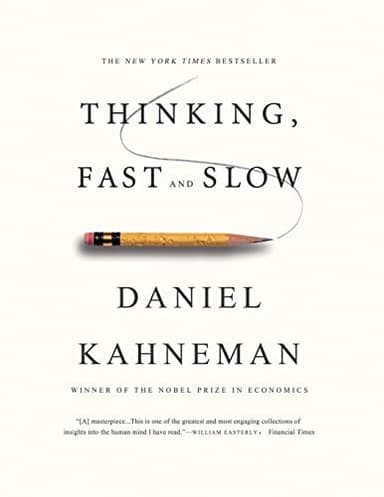
Thinking, Fast and Slow (2011)
About This Book
A Nobel Prize-winning psychologist summarizes decades of research into the two systems that govern human thought: System 1, which is fast, intuitive, and emotional, and System 2, which is slow, deliberate, and logical, and demonstrates how the interplay between these systems produces the cognitive biases that shape our judgments, decisions, and beliefs. Daniel Kahneman wrote the book that changed how we understand our own minds.
Why It's a Classic
Kahneman's work, conducted over decades in collaboration with Amos Tversky, demonstrated that human beings are not the rational actors that economists and philosophers assumed: we are systematically biased in predictable ways, overweighting losses relative to gains, anchoring our judgments to irrelevant numbers, substituting easy questions for hard ones, and believing ourselves to be more consistent, rational, and knowledgeable than we actually are. The book's genius is making these technical findings accessible and personally relevant: reading it is a humbling experience because you recognize your own thought patterns in the biases Kahneman describes. The concepts of loss aversion, anchoring, the availability heuristic, and the planning fallacy have entered common usage because they name experiences that everyone has but few can articulate. Kahneman's work has had practical implications far beyond psychology, influencing economics (behavioral economics emerged directly from his research), medicine (improving diagnostic accuracy), law (revealing biases in sentencing), and public policy (the 'nudge' movement).
Fun Fact
Kahneman shared the Nobel Prize in Economics in 2002 despite never having taken an economics course; his work with Tversky (who died in 1996 and was therefore ineligible for the prize) essentially created the field of behavioral economics. Michael Lewis wrote a book about the Kahneman-Tversky partnership called 'The Undoing Project.' Kahneman has acknowledged that some of the studies he cites in the book have failed to replicate in subsequent research, a limitation he has addressed publicly with characteristic intellectual honesty. He spent five years writing the book, testing each chapter on friends and colleagues and rewriting extensively based on their feedback.
Parent Note
The book is intellectually demanding but clearly written, with numerous examples and thought experiments that make abstract concepts concrete. There is no objectionable content in terms of violence, sexuality, or language. Some statistical concepts require attention, and the book is long (roughly 500 pages). The discussion of cognitive biases can be unsettling for readers who prefer to believe in their own rationality. Suitable for readers sixteen and up with an interest in psychology, economics, or decision-making. One of the most important popular science books of the twenty-first century.
Quick Facts
- Year
- 2011
- Type
- 📚 Book
- Category
- Philosophy & Ideas
- Age Group
- Adults (Ages 18+)