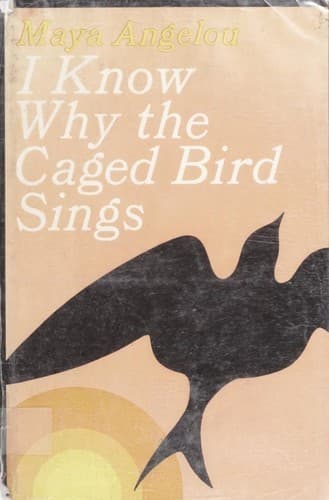
I Know Why the Caged Bird Sings (1969)
About This Book
Maya Angelou's memoir begins in the rural town of Stamps, Arkansas, where she and her brother are raised by their grandmother after their parents' marriage falls apart. She writes about the Black church, the cotton fields, the casual brutality of segregation, and the transformative moment when a teacher introduced her to literature. Angelou's prose has the rhythm and power of spoken word, turning a childhood of hardship into a story of survival through language, dignity, and community.
Why It's a Classic
Angelou's memoir broke ground in 1969 by speaking openly about experiences that Black women were rarely permitted to discuss in public: racism, sexual abuse, teenage pregnancy, and the complex shame and resilience those experiences produce. Her writing style blends the traditions of Southern storytelling, African American oral culture, and literary modernism into something entirely her own. The book's most devastating passage describes her assault at age eight and the silence that followed, rendered with a restraint that makes the horror more palpable, not less. Angelou went on to become one of the most celebrated voices in American letters, reading her poem 'On the Pulse of Morning' at President Clinton's inauguration. The memoir is the first of seven autobiographical volumes, but it stands alone as a complete and powerful work, and its influence on memoir as a genre cannot be overstated.
Fun Fact
Angelou did not intend to write the memoir; her friend James Baldwin and editor Robert Loomis challenged her by saying most autobiographies were impossible to write well as literature, knowing that framing it as a dare would appeal to her competitive nature. Before becoming a writer, Angelou worked as the first Black female streetcar conductor in San Francisco, a calypso dancer, and an actress. She spoke six languages fluently and spent several years living in Ghana and Egypt.
Parent Note
The memoir describes the sexual assault of a child, which is handled with literary restraint but is unmistakably present and central to the narrative. It also depicts the violent death of the assailant, racial violence, and the psychological effects of racism on children. Angelou describes her teen pregnancy frankly. These subjects are integral to the book's power and honesty, and they are treated with gravity rather than sensationalism. It is typically assigned around ages 14 to 16.
Quick Facts
- Year
- 1969
- Type
- 📚 Book
- Category
- Non-Fiction / Biography
- Age Group
- Teens (Ages 14–17)