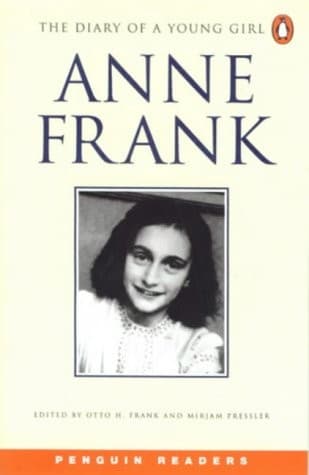
The Diary of a Young Girl (1947)
About This Book
Anne Frank was thirteen when her Jewish family went into hiding in a concealed annex above her father's office in Nazi occupied Amsterdam. For two years she wrote in her diary about fear, boredom, family arguments, her first crush, and her dreams of becoming a writer. Her voice is so vivid and immediate that you forget you are reading history and feel instead like you are reading the private thoughts of a girl you know.
Why It's a Classic
Anne Frank's diary is the most widely read personal document from the Holocaust, translated into over 70 languages, because it puts a singular human voice to an event of incomprehensible scale. What makes the diary extraordinary is not just its historical context but its literary quality; Anne revised her entries with a writer's eye, consciously shaping them into something she hoped would be published after the war. She writes about her mother with unflinching adolescent honesty, about Peter van Pels with the breathless uncertainty of first love, and about her own ambitions with a clarity that makes her death at Bergen Belsen feel like a personal loss rather than a statistic. Her father Otto, the only family member to survive, spent the rest of his life ensuring her words reached the world. The diary stands as both a historical document and a portrait of adolescence so specific and alive that it transcends its terrible context.
Fun Fact
Anne actually kept two versions of her diary: the original and a revised edition she began after hearing a radio broadcast from the Dutch government in exile asking citizens to preserve their wartime diaries for future publication. The published version is a combination of both, edited by Otto Frank. The chestnut tree Anne could see from the annex window, which she wrote about as a source of comfort, stood until 2010, when it fell in a storm; saplings grown from its seeds have been planted at memorial sites around the world.
Parent Note
The diary deals with living under the threat of discovery and deportation, and readers who know the historical outcome will read it with awareness that Anne died in Bergen Belsen at age fifteen. Anne writes frankly about puberty, her body, and her first romantic feelings, which her father initially edited out of the published version and which were restored in later 'definitive' editions. The emotional weight of reading a murdered girl's private hopes and dreams can be overwhelming. It is assigned in most schools around ages 12 to 14.
Quick Facts
- Year
- 1947
- Type
- 📚 Book
- Category
- Non-Fiction / Biography
- Age Group
- Teens (Ages 14–17)