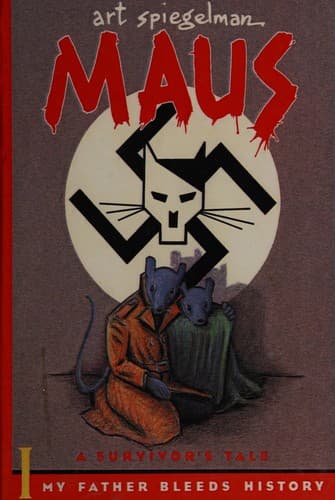
Maus (1986)
About This Book
Art Spiegelman draws his father Vladek's experience surviving the Holocaust, depicting Jews as mice, Germans as cats, and Poles as pigs in a visual metaphor that is both startlingly simple and deeply unsettling. The story alternates between Vladek's wartime memories and Art's present day struggle to record them, revealing the friction between father and son alongside the historical horror. It is the most important graphic novel ever published, and its power comes from the tension between its cartoon form and the enormity of what it depicts.
Why It's a Classic
Spiegelman spent thirteen years creating Maus, serializing it in his avant garde comics magazine Raw, and the result changed what the world believed comics could accomplish. The animal metaphor, which initially seems reductive, actually forces readers to confront how dehumanization works, making the racial categorizations of the Nazi regime visible in every panel. The intergenerational narrative is equally important; Art's difficult relationship with his demanding, neurotic father Vladek shows how trauma echoes across generations, affecting people who never experienced it directly. In 1992, Maus became the only graphic novel ever to win the Pulitzer Prize, and the committee had to create a special category because it did not fit existing ones. The book was controversially banned by a Tennessee school board in 2022, which triggered a massive spike in sales and introduced it to a new generation of readers.
Fun Fact
Spiegelman originally created the concept as a three page strip in 1972 for a comics anthology called Funny Aminals, fourteen years before the full graphic novel began serialization. Vladek Spiegelman's actual Auschwitz prisoner number was tattooed on his arm and is reproduced in the book. The 2022 banning by the McMinn County, Tennessee school board cited nudity (mice depicted without clothes) and profanity, which Spiegelman called 'Orwellian' in its reasoning.
Parent Note
Maus depicts the Holocaust in detail, including deportations, concentration camp conditions, gas chambers, and the murder of children, all rendered in black and white illustrations. The animal metaphor provides some emotional distance but does not soften the content significantly. There is brief nudity (drawn on mouse characters), profanity, and depictions of suicidal despair. The intergenerational trauma narrative can also be emotionally intense. It is typically used in classrooms from ages 13 and up, and it is an extraordinary tool for teaching both history and the possibilities of graphic storytelling.
Quick Facts
- Year
- 1986
- Type
- 📚 Book
- Category
- Graphic Novels / Comics
- Age Group
- Teens (Ages 14–17)