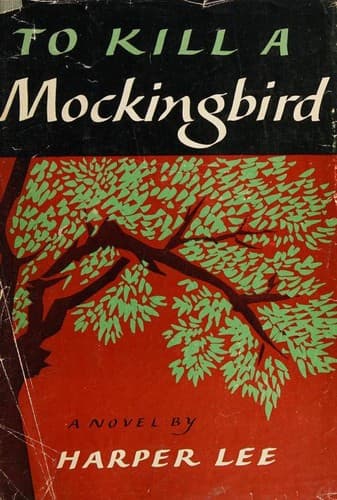
To Kill a Mockingbird (1960)
About This Book
Scout Finch is six years old when her father, the lawyer Atticus Finch, agrees to defend Tom Robinson, a Black man falsely accused of assaulting a white woman in 1930s Alabama. Through Scout's eyes, the reader watches a small town reveal its deepest prejudices and its fragile capacity for decency. Lee's writing is warm, funny, and ultimately devastating in its portrait of injustice.
Why It's a Classic
Harper Lee won the Pulitzer Prize for this, her only published novel for over fifty years, and it has been assigned in more American classrooms than any other work of fiction. Atticus Finch became the moral ideal of an entire profession; surveys consistently show he is the most cited reason people say they went to law school. Lee's achievement was in making the story accessible through a child's perspective, allowing Scout's innocence to highlight the absurdity and cruelty of racial prejudice without resorting to didacticism. The novel also captures the texture of small town Southern life with extraordinary precision, from the summer rhythms of Maycomb to the terrifying figure of Boo Radley. Its limitations, including its centering of white characters in a story about racial injustice, have become the subject of important contemporary criticism, which makes reading it today an even richer experience.
Fun Fact
Lee based Atticus Finch on her own father, Amasa Coleman Lee, a lawyer in Monroeville, Alabama, who once defended two Black men accused of murder. Her childhood neighbor and best friend was Truman Capote, who became the model for the character Dill. Lee assisted Capote in researching In Cold Blood in Kansas, though their friendship later deteriorated.
Parent Note
The novel deals directly with racial prejudice, a false rape accusation, and a trial that depicts systemic injustice. The racial slur appears multiple times in the text as part of its historical accuracy. There is also a violent attack on children near the end of the book. These elements are handled with sensitivity but are integral to the story and should be discussed. It is widely taught starting around age 13.
Quick Facts
- Year
- 1960
- Type
- 📚 Book
- Category
- Classics / Literature
- Age Group
- Teens (Ages 14–17)