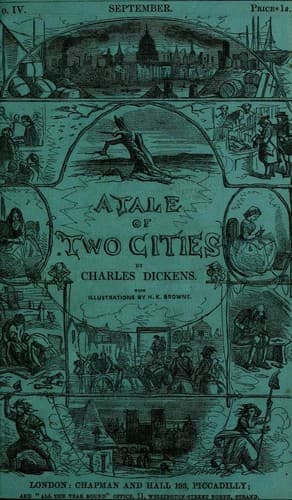
A Tale of Two Cities (1859)
About This Book
Against the backdrop of the French Revolution, a French aristocrat imprisoned for eighteen years is reunited with his daughter in London, while a dissolute English lawyer discovers that love might give his wasted life meaning, and the terror of the guillotine draws all of them back to Paris for a climax of sacrifice and redemption. Charles Dickens opened with literature's most famous first line and closed with its most famous last.
Why It's a Classic
Dickens understood the French Revolution as both a justified response to aristocratic cruelty and a descent into collective madness, and the novel holds both truths simultaneously without flinching from either. Madame Defarge, who knits the names of those condemned to die into a register she carries everywhere, is one of the great figures of implacable vengeance, a woman whose personal trauma has been transmuted into revolutionary fury that cannot be satisfied. Sydney Carton's final sacrifice ('It is a far, far better thing that I do, than I have ever done') is one of the most emotionally devastating moments in all of fiction, a redemption earned not through reform but through a single act of absolute selflessness. The novel's structure, cutting between London's stability and Paris's chaos, creates a sense of historical momentum that sweeps the reader along, and the scenes of mob violence during the Revolution are among the most vivid in English literature. The novel has sold over 200 million copies, making it one of the bestselling books ever published.
Fun Fact
Dickens drew heavily on Thomas Carlyle's 'The French Revolution: A History' for his depiction of the Revolution, and reportedly asked Carlyle to send him two cartloads of books for research. The novel was serialized in All the Year Round from April to November 1859. Dickens performed dramatic readings of the novel's climactic scenes, and these performances were so emotionally exhausting that his doctor warned him they were damaging his health. The opening sentence ('It was the best of times, it was the worst of times, it was the age of wisdom, it was the age of foolishness...') runs for 119 words and is the most parodied opening in English literature. Despite being one of the bestselling novels of all time, it is not considered Dickens' finest achievement by most literary critics, who tend to prefer Bleak House or Great Expectations.
Parent Note
The novel contains scenes of revolutionary violence including mass executions by guillotine, mob violence, the storming of the Bastille, imprisonment, and the threat of death throughout the final third. Characters are described suffering under aristocratic oppression, and the violence of the Revolution is presented as both justified and horrifying. A child is killed by a carriage. Sydney Carton's alcoholism is central to his character. No sexual content or strong language. The prose is Victorian and occasionally melodramatic. The novel is roughly 400 pages. Suitable for readers fourteen and up. A powerful introduction to historical fiction and to the French Revolution.
Quick Facts
- Year
- 1859
- Type
- 📚 Book
- Category
- Classic Novels
- Age Group
- Adults (Ages 18+)