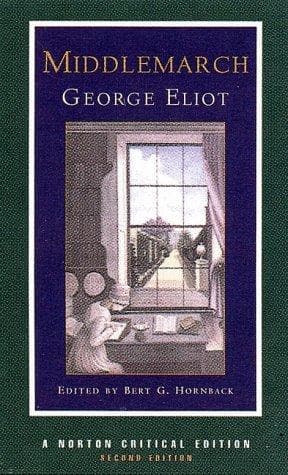
Middlemarch (1871)
About This Book
In the fictional English town of Middlemarch during the period of the Reform Bill of 1832, a young woman with grand ideals makes a disastrous marriage to a pedantic scholar, a young doctor with ambitious plans encounters the obstacles of provincial society, and a web of interconnected lives reveals how individual aspiration is shaped, limited, and sometimes crushed by the society in which it operates. George Eliot wrote the most psychologically rich and morally intelligent novel in the English language.
Why It's a Classic
Eliot's narrator is one of the great achievements of Victorian fiction: a voice of extraordinary empathy and penetrating intelligence that moves between characters' inner lives with such fluidity that the reader comes to understand not just what people do but why they do it, and how their reasons, however inadequate, make sense from the inside. Dorothea Brooke's disastrous marriage to Casaubon, a man whose life's work turns out to be a catalogue of dead knowledge, is one of the most devastating depictions of a young person's idealism meeting reality's immovable limitations. Lydgate, the idealistic doctor whose medical ambitions are undermined by his marriage to the beautiful, materialistic Rosamond Vincy, provides a parallel study of how good intentions are destroyed by the wrong partnership. Eliot's moral vision is neither cynical nor sentimental: she shows her characters making mistakes, suffering consequences, and occasionally finding grace, and she treats every one of them, even the failures, with a generosity that makes the reader more humane. Virginia Woolf called it 'one of the few English novels written for grown-up people.'
Fun Fact
George Eliot was the pen name of Mary Ann Evans, who used a male pseudonym to ensure her work would be taken seriously. The novel was published in eight installments between December 1871 and December 1872, and Eliot was already the most respected novelist in England when she wrote it. Casaubon's futile scholarly project, 'A Key to All Mythologies,' is widely interpreted as a satire on scholarly pretension and the danger of spending a lifetime on a work that is obsolete before it is finished. Eliot conducted extensive research into the Reform Bill period, medical practice, political history, and provincial life to ensure the novel's accuracy. The novel fell out of fashion after Eliot's death and was rescued by Virginia Woolf's advocacy and by twentieth century feminist critics who recognized its pioneering treatment of women's intellectual ambitions.
Parent Note
The novel contains themes of marital unhappiness, financial ruin, social hypocrisy, political corruption, and the frustration of women's ambitions by patriarchal society. There is a death and a scandal involving a will. No graphic violence, sexual content, or strong language. The prose is Victorian and intellectually demanding, with long, complex sentences that reward careful reading. The novel is roughly 800 pages and has a large cast of characters. Suitable for readers seventeen and up. Widely regarded as the greatest novel in the English language, though its pacing and style require patience.
Quick Facts
- Year
- 1871
- Type
- 📚 Book
- Category
- Classic Novels
- Age Group
- Adults (Ages 18+)