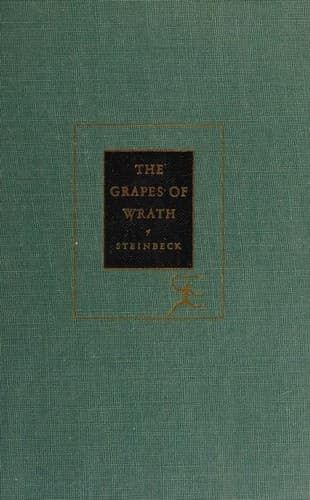
The Grapes of Wrath (1939)
About This Book
The Joad family, driven from their Oklahoma farm by the Dust Bowl and the mechanization of agriculture, loads everything they own onto a broken-down truck and heads for California, where the promise of work and orchards turns out to be a lie designed to exploit desperate people. John Steinbeck wrote the novel that defined the Great Depression for America, a book so politically charged that it was banned, burned, and called communist propaganda, and so emotionally powerful that it won the Pulitzer Prize.
Why It's a Classic
Steinbeck's achievement was making the political personal and the personal political: the Joad family's specific suffering (their lost farm, their broken truck, their hunger, their dignity in the face of contempt) is rendered with such concrete, physical detail that the reader cannot retreat into abstraction, and the 'intercalary' chapters, which step back to describe the broader forces of economics, ecology, and migration, give the family's story the weight of historical necessity. Ma Joad is one of the great matriarchs of American fiction, a woman whose strength holds the family together when everything else fails, and her quiet determination in the face of indifference and cruelty is more powerful than any speech. Tom Joad's farewell, in which he tells his mother he will be present wherever there is injustice, has become one of the most quoted passages in American literature and was adapted by Bruce Springsteen into one of his most celebrated songs. The final scene, in which Rose of Sharon nurses a starving stranger, is an act of radical human generosity that transcends the novel's politics.
Fun Fact
Steinbeck wrote the novel in five months, working from the research he had done among migrant workers in California for a series of newspaper articles. The novel was publicly burned by the Associated Farmers of California, banned in multiple counties, and denounced by Oklahoma congressman Lyle Boren as 'a dirty, lying, filthy manuscript.' Eleanor Roosevelt defended the novel and used it to advocate for migrant worker protections. Steinbeck won the Pulitzer Prize for the novel in 1940 and the Nobel Prize in Literature in 1962, though the Nobel committee cited his body of work rather than this novel specifically. John Ford's 1940 film adaptation, starring Henry Fonda, is considered one of the greatest American films.
Parent Note
The novel contains extreme poverty, starvation, violence (including a murder committed by Tom Joad), the death of family members, exploitation of workers, police brutality against migrants, and a final scene involving breastfeeding a dying stranger that some readers find shocking. The language includes period-appropriate profanity and racial terms. The intercalary chapters slow the narrative pace for some readers. Steinbeck's sympathies are explicitly with the workers and against the landowners, and the novel does not pretend to political neutrality. The novel is roughly 450 pages. Suitable for readers fifteen and up. Essential American literature.
Quick Facts
- Year
- 1939
- Type
- 📚 Book
- Category
- Classic Novels
- Age Group
- Adults (Ages 18+)