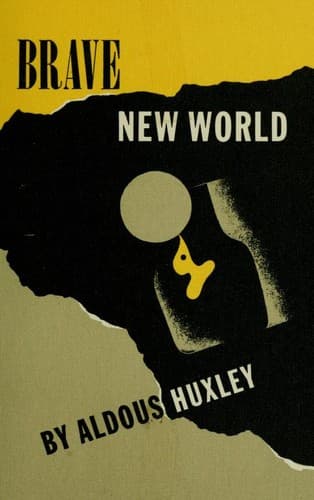
Brave New World (1932)
About This Book
In the World State, humans are grown in bottles, sorted into castes, and kept docile with recreational drugs and engineered pleasures. Nobody suffers, nobody questions, and nobody reads Shakespeare. When a man raised outside this system arrives, his encounter with engineered happiness becomes a collision between freedom and comfort that neither side survives.
Why It's a Classic
Aldous Huxley predicted genetic engineering, antidepressant culture, and the numbing effects of endless entertainment nearly a century before they became realities. While Orwell imagined tyranny through pain, Huxley imagined something arguably more unsettling: tyranny through pleasure, a world where people surrender freedom voluntarily because they are too comfortable to care. The novel's Bokanovsky Process, where a single embryo is split into dozens of identical workers, anticipated cloning decades before Dolly the sheep. Huxley was also remarkably prescient about consumer culture, depicting a society where citizens are conditioned from birth to consume and discard. The debate between Huxley's vision and Orwell's has become a perennial question: which dystopia did we actually end up living in?
Fun Fact
Huxley was the grandson of Thomas Henry Huxley, who was known as 'Darwin's Bulldog' for his fierce defense of evolution, giving the novel's themes of biological engineering a personal family dimension. Huxley taught George Orwell French at Eton, making the two great dystopian writers literally teacher and student. He wrote Brave New World in just four months while living in the south of France.
Parent Note
The novel contains frank discussions of sexuality, including promiscuity as a social norm and references to children engaging in sexual play, which is presented as part of the World State's disturbing social engineering. Drug use (soma) is depicted throughout, though critically. There is a scene of self flagellation and a disturbing ending. The sexual content in particular is more explicit in implication than many school assigned books, so it is best suited for teens 14 and up who can engage with it as social criticism.
Quick Facts
- Year
- 1932
- Type
- 📚 Book
- Category
- Fantasy / Sci-Fi
- Age Group
- Teens (Ages 14–17)