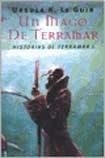
The Earthsea Quartet: A Wizard of Earthsea (1968)
About This Book
Young Ged, a goatherd's son with raw magical talent, enters a school for wizards and rashly unleashes a shadow creature that hunts him across the archipelago world of Earthsea. Le Guin's prose is spare and luminous, carrying the weight of myth in every carefully chosen sentence. This is fantasy that reads like poetry and stays with you like a dream.
Why It's a Classic
Ursula K. Le Guin wrote A Wizard of Earthsea partly as a response to the whiteness of fantasy fiction, setting her story in a world where most characters are brown or black skinned. The magic system is built on the idea that knowing the true name of a thing gives you power over it, which turns language itself into the source of magic. Le Guin's central theme, that Ged must face and accept his own shadow rather than flee from it, draws on Jungian psychology and Taoist philosophy in ways that feel organic rather than preachy. Her prose is famously disciplined, achieving in 200 pages what many fantasy authors fail to accomplish in a thousand. The Earthsea books influenced generations of writers, and their insistence that wisdom matters more than power remains quietly revolutionary in a genre often obsessed with spectacle.
Fun Fact
Le Guin wrote the book after a publisher asked her to write something for older children, and she produced a novel that many adult readers consider superior to The Lord of the Rings in its prose quality. Earthsea predates Harry Potter's wizarding school by thirty years, and the parallels between Roke and Hogwarts are striking. Le Guin was deeply unhappy with the 2004 Studio Ghibli adaptation, saying it missed the point of her work, though she later softened her criticism somewhat.
Parent Note
The novel deals with a young man confronting his own darkness, which can feel psychologically intense even though the actual events are not graphic. There is very little violence, no romance, and no profanity. The prose style is literary and measured, which some action oriented readers may find slow. It is appropriate for ages 11 and up and makes an excellent introduction to literary fantasy.
Quick Facts
- Year
- 1968
- Type
- 📚 Book
- Category
- Fantasy / Sci-Fi
- Age Group
- Teens (Ages 14–17)