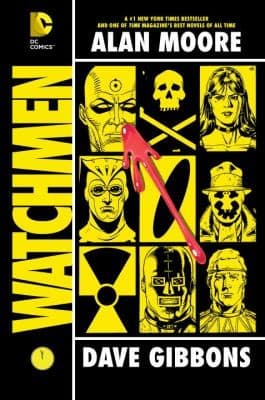
Watchmen (1986)
About This Book
In an alternate 1985 where Richard Nixon is still president and masked vigilantes have been outlawed, someone is killing former superheroes. The investigation pulls the reader into a densely layered narrative that deconstructs the very idea of the superhero, asking what kind of person would actually put on a costume and fight crime, and whether the answer should terrify us. Moore and Gibbons created a work so structurally intricate that new details emerge on every rereading.
Why It's a Classic
Alan Moore and Dave Gibbons did not just write a great superhero story; they dismantled the genre and examined every assumption it rested on. Each of the central characters represents a different archetype taken to its logical and disturbing conclusion: the godlike being who loses touch with humanity, the billionaire who believes his intelligence justifies any action, the vigilante whose rigid morality is indistinguishable from psychopathy. Gibbons's nine panel grid creates a visual rhythm that Moore uses for extraordinary effects, including an issue structured as a perfect palindrome. The book also functions as an alternate history of the Cold War, exploring how the existence of a genuine superman would reshape geopolitics. Time magazine named Watchmen one of the 100 best English language novels published since 1923, placing it alongside works by Joyce, Nabokov, and Morrison.
Fun Fact
Moore originally planned to use existing characters that DC Comics had acquired from Charlton Comics, but DC realized his story would render those characters unusable for future stories, so he was asked to create original analogues. The recurring symbol of the smiley face with a blood splatter was not in Moore's original script; Gibbons added it, and it became the most iconic image in comics history. Moore has famously refused to see any of the film or television adaptations of his work and has asked to have his name removed from all of them.
Parent Note
Watchmen contains graphic violence, including murder and a mass casualty event depicted in disturbing detail. There is an attempted sexual assault, explicit sexual content, and full nudity. The story deals with Cold War nuclear anxiety, moral relativism, and deeply flawed characters who commit terrible acts. The philosophical complexity and mature content make it best suited for older teens 16 and up who are ready for a genuinely adult graphic novel. It is not a typical superhero story and should not be approached as one.
Quick Facts
- Year
- 1986
- Type
- 📚 Book
- Category
- Graphic Novels / Comics
- Age Group
- Teens (Ages 14–17)