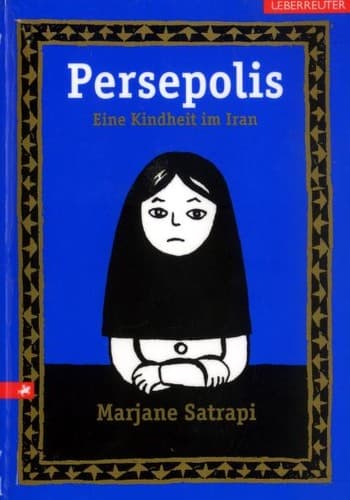
Persepolis (2000)
About This Book
Marjane Satrapi was ten years old when the Islamic Revolution transformed Iran, and her memoir in stark black and white panels traces her journey from a rebellious child in Tehran to a lonely teenager in Vienna and back again. Satrapi draws herself as a small, defiant figure against the enormous forces of history, finding humor and humanity in circumstances that could easily overwhelm. The art is deceptively simple, with bold lines and minimal detail that somehow convey more emotion than photorealism could.
Why It's a Classic
Satrapi achieved something remarkable by making the Iranian Revolution comprehensible and personal for Western readers without ever simplifying it. Her family's story, progressive intellectuals caught between the brutality of the Shah and the repression of the new theocracy, demolishes the idea that Iran is a monolithic culture. The memoir's power comes from its specific, often funny details: young Marjane pretending to be a revolutionary, listening to Iron Maiden tapes smuggled under her veil, arguing with God in her bedroom. Satrapi also refuses to present herself as a pure hero, honestly depicting her own selfishness, cowardice, and mistakes during her years in Europe. The graphic novel format allows her to convey political history, personal memory, and emotional truth simultaneously in ways that prose alone could not accomplish.
Fun Fact
Satrapi drew the entire book by hand using India ink, a technique that gives the art its distinctive high contrast look. She has said she chose black and white deliberately because color would have made the images 'too real' and might have overwhelmed the reader with the violence depicted. The animated film adaptation, which Satrapi co directed, was nominated for the Academy Award for Best Animated Feature in 2008 and was banned in Iran.
Parent Note
The memoir depicts political executions, war (including bombing), torture (discussed rather than graphically shown), and the harassment of women under the new theocratic regime. There are scenes of teenage drug use and a suicide attempt during Satrapi's time in Vienna. The emotional content of displacement and cultural alienation is significant. There is some profanity. It is appropriate for ages 13 and up, and it is especially valuable for teens interested in world history, feminism, or understanding cultures different from their own.
Quick Facts
- Year
- 2000
- Type
- 📚 Book
- Category
- Graphic Novels / Comics
- Age Group
- Teens (Ages 14–17)