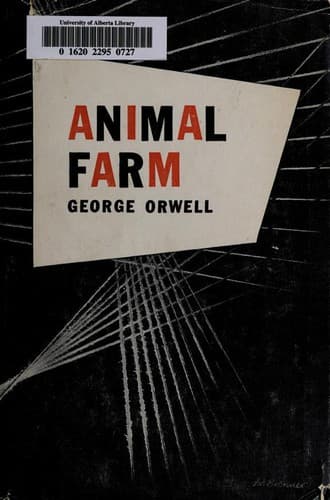
Animal Farm (1945)
About This Book
The animals of Manor Farm overthrow their drunken owner and establish a society based on equality, only to watch in helpless confusion as the pigs gradually take over and become indistinguishable from the humans they replaced. Orwell tells this story with the simplicity of a children's fable, which makes its political ruthlessness hit even harder. You will finish it in an afternoon, and the last page will follow you for years.
Why It's a Classic
Orwell wrote this as a direct allegory of the Russian Revolution and Stalin's betrayal of socialist ideals, mapping each character onto a historical figure: Napoleon is Stalin, Snowball is Trotsky, Boxer the horse is the exploited working class. The novel was rejected by multiple publishers during World War II because the Soviet Union was a British ally and criticizing Stalin was politically inconvenient; one rejection letter came from T.S. Eliot at Faber and Faber. Orwell's genius was in choosing the fable form, which makes the political message accessible to readers of any age while also giving it a timeless quality that transcends its specific historical moment. The commandment 'All animals are equal, but some animals are more equal than others' has become one of the most quoted lines in political literature. The novel works as a warning not just about Soviet communism but about any revolution that concentrates power in the hands of those who claim to serve the people.
Fun Fact
Orwell's wife Eileen helped him type the manuscript, and he stored the only copy in a drawer during the London Blitz, risking its destruction by bombing. The novel was initially rejected by four publishers, including one who consulted the British Ministry of Information about whether it was appropriate to publish during the wartime alliance with the Soviet Union. In the original ending, the other animals could still distinguish between pigs and humans; Orwell revised it so they could not, making the conclusion far more devastating.
Parent Note
The novel depicts animal violence, including the execution of animals who confess to crimes, a horse being sent to a glue factory, and a general atmosphere of political oppression. The language is simple and the book is short, making it accessible to younger readers, though the political allegory becomes richer with some knowledge of the Russian Revolution. There is no sexual content or profanity. It is appropriate for ages 11 and up.
Quick Facts
- Year
- 1945
- Type
- 📚 Book
- Category
- Classics / Literature
- Age Group
- Teens (Ages 14–17)